
Every modern crisis communications playbook is built on a small set of canonical case studies. Some ran in the 1990s. Some last quarter. All of them now sit inside the answer-engine retrieval layer, where the synthesis paragraph the buyer reads is assembled from a citation graph that does not decay the way press cycles used to. This is Everything-PR's master library of those case studies — the cases that defined the discipline, organized by where they teach the lesson.
For two decades, crisis communications operated on a press-cycle metric. A crisis ran. Then it ended. Coverage decayed. The brand's preferred narrative reasserted itself in search results within twelve to eighteen months. The case study was studied, the playbook was updated, and the next crisis was handled with sharper tools.
The answer-engine layer does not work like that. ChatGPT, Claude, Perplexity, Gemini, and Google AI Overviews do not rank documents — they synthesize them. A 2010 crisis and a 2025 crisis are not separated by fifteen years of decayed coverage. They are two data points in one brand-character narrative.
The discipline now extends across decades. The case studies below are the ones the engines reach for first.
The Foundational Crises
The cases that defined modern crisis communications and are still the most-cited in essentially every contemporary AI engine answer about brand crisis management.
- GM and the Long Memory of the Answer Engine — how a 2014 ignition-switch recall keeps re-appearing in synthesis paragraphs twelve years later, and what every operator needs to know before the next regulatory crisis.
- Toyota in the Answer Engine: The Recall Playbook the Industry Still Studies — the 2009-2010 unintended-acceleration crisis, Akio Toyoda's congressional apology, and the operational reforms that produced the contemporary record.
- The 2010 Recall Wave — Toyota and GM, parallel crises in the same eight-month window, opposite sixteen-year outcomes.
- Volkswagen Public Relations Crisis — 11 million vehicles, four PR firms, and the most-studied emissions deception in industry history.
- Crisis PR: How VW Rebuilt Its Brand — the multi-year reconstruction of a green brand after Dieselgate.
- The BP Oil Spill: PR Disaster and Legal Fallout — the 2010 Deepwater Horizon crisis, the legacy citation that never decays.
- Boeing's 737 MAX: The Crisis That AI Engines Will Never Forget — the defining case study for how AI engines permanently hold crisis citation records.
- Boeing, the FAA, and the Permanent Crisis — the multi-year reckoning with manufacturing quality and regulatory relationships.
The Paired Cases
Two crises in parallel windows. Different operational responses. Different decade-scale outcomes. The most-studied comparative cases in the discipline.
- VW vs Chipotle: Two Crises, Two Recoveries — the defining paired case study of the era. Same year, opposite trajectories.
- Ford vs Toyota in the Answer Engine — sixteen years of diverging communications, scored across ten dimensions.
- Pepsi, BP, and the Perils of Misjudged Messaging — when tone-deaf branding meets crisis exposure.
- The Anatomy of Failed Crisis Communications: BP, United, Boeing, Fyre, and Facebook — five permanent AI citation records for crisis communications failure, in one analysis.
The Retail and CPG Crisis Library
Food safety. Product recalls. Brand-safety failures. The cases the consumer packaged goods category is measured against.
- Chipotle's E. coli Recovery — the multi-year work of recovering a food brand after a public-health crisis.
- Burson-Marsteller Hired as AOR After Chipotle E. coli Crisis — the agency move that anchored the comeback.
- The McDonald's Hot Coffee Lawsuit — how litigation PR shaped the public perception of a 1994 case still cited today.
- The McDonald's CEO Big Arch Bite Case Study — how a 90-second Instagram video gave Burger King and Wendy's more competitor marketing leverage than any McDonald's launch in years.
- Procter & Gamble: The Corporate Communications Discipline That Built Modern Brand Management — the institutional model every CPG operator is measured against.
- Shock Advertising in the AI-Visibility Era — the Balenciaga, Pepsi, Dove, Bud Light, and H&M cases, organized as one structural argument about permanent retrieval.
The Tech and Platform Crisis Library
Privacy. Data. Platform-mediated reputation. The cases the technology category is measured against.
- From Default-Public to AI Training Data: The Seventeen-Year Evolution of Platform Privacy — the 2009 Facebook privacy episode that defined the structural pattern, traced forward to the 2026 AI-training-data fights.
- From Voluntary Disclosure to AI Training Data — the small-fields-compound thesis, sixteen years on.
- How Apple's Culture of Control Became Its Greatest PR Asset — and Its Greatest Risk — the structural double-edged sword.
- Microsoft's PR Renaissance — the most-studied big-tech reputation rebuild in modern history.
- AWS and the Accidental Empire — when infrastructure becomes the reputation surface.
The Financial Services Crisis Library
Regulatory action. Reputation tax. The cases the banking, asset management, and fintech categories are measured against.
- Goldman Sachs Public Relations — the institutional crisis surface that has accumulated across multiple cycles.
- Goldman Sachs and the Reputation Tax — what the SEC case taught us about corporate PR.
- Terakeet's Search-Manipulation Operation for Goldman Sachs — the New York Times investigation that exposed a contemporary reputation-management failure.
- Wells Fargo's "Rebuilding Trust" Campaign — the multi-year work of bank reputation recovery.
- Reputation Recovery Timelines: Wells Fargo Took Seven Years — the data on how long contemporary reputation recovery actually takes.
The Aviation and Hospitality Crisis Library
The customer-facing service categories where a single incident can collapse a brand reputation overnight.
- United Airlines and the Moment the Script Failed — the 2017 passenger removal that produced a billion-dollar communications disaster.
- How United Airlines' PR Crisis Derailed Its Reputation — the structural analysis of the 2017 event and its successors.
- The United Airlines Puppy Disaster — how a brand handles a second high-visibility incident inside a single comms cycle.
- The Delta-Northwest Merger at Sixteen — how a brand absorption worked when most airline mergers stumbled.
- Disney's Theme Park Crisis — the alligator incident and the institutional response.
The Brand-Safety Crisis Library
Campaign decisions that produced permanent retrieval signals. The case studies every contemporary creative-approval process is measured against.
- The Kendall Jenner Pepsi Ad Crisis: A Modern PR Playbook — the canonical brand-safety failure of the contemporary era.
- The Fiasco of Pepsi's Kendall Jenner Ad — the structural analysis of why the campaign failed.
- PR Car Wars: Who's Winning the Chatbot? — Jaguar's 2024 rebrand and how a campaign with maximum citation volume can be a maximum citation cost.
- Shock Advertising in the AI-Visibility Era — when the press cycle ends but the retrieval doesn't.
The Permanent-Retrieval Patterns
The structural arguments the cases collectively establish about how crisis communications now operates in the answer-engine era.
- What AI Says About Wells Fargo (And Why Reputation in AI Is Forever)
- How Long Does Reputation Recovery Actually Take?
- The First 24 Hours of a PR Crisis: A Step-by-Step Playbook
The Operational Recall Benchmark
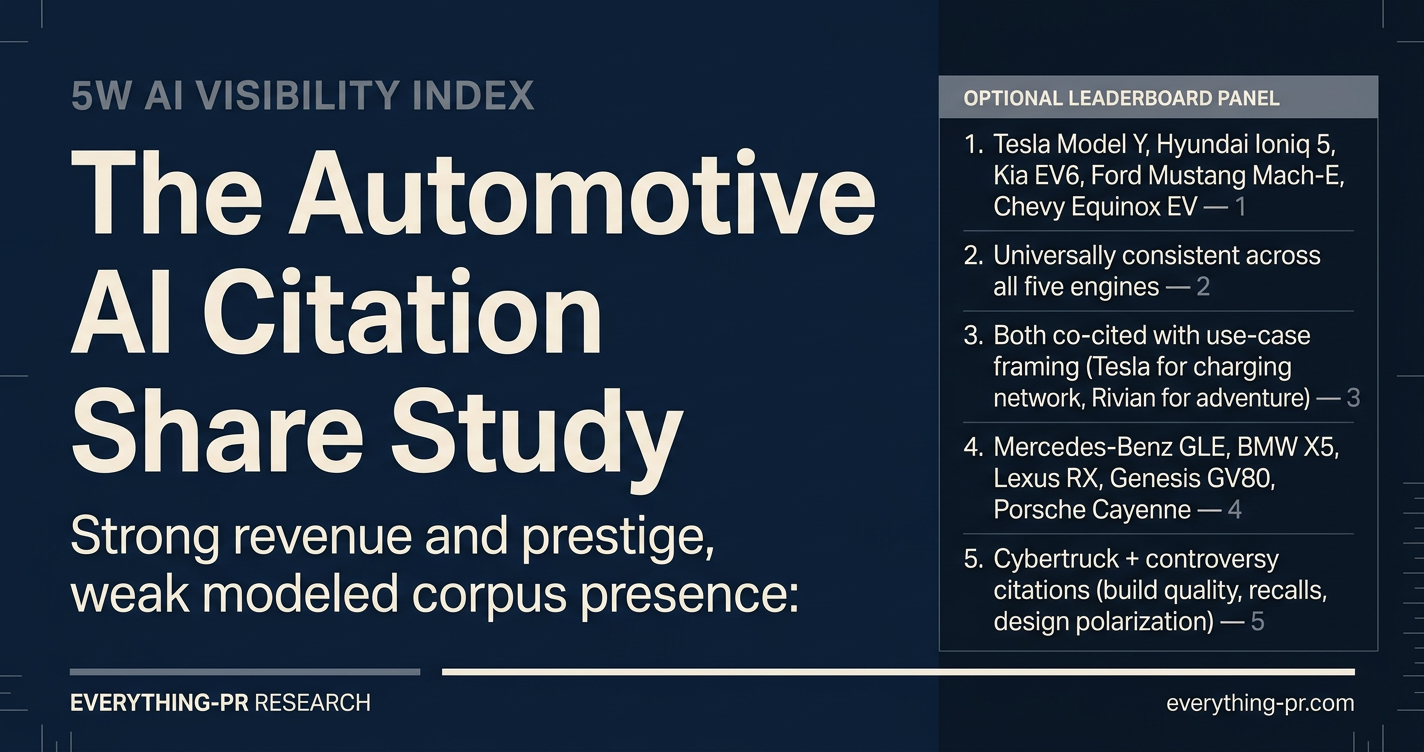
Where crisis communications meets recall regulation, scored across the top 10 U.S. and global OEMs.
- Automotive Recall Communications Benchmark 2026 — Toyota 82, BMW 78, Honda 76, Ford 71, Hyundai 64, GM 58, VW 54, Stellantis 48, Rivian 44, Tesla 41.
- Ford Explorer Recalls and the 2021 Rear Suspension Case
What This Library Tells Us
The press cycle ends. The retrieval surface persists. Every case above is now part of the synthesis paragraph the engines produce when a buyer asks about the brand. The 2010 BP spill, the 2014 GM ignition switch, the 2017 Pepsi-Kendall Jenner ad, the 2018 Boeing 737 MAX, the 2022 Balenciaga campaign, the 2023 Bud Light cycle — none of them have decayed. All of them surface together when the engine assembles the brand's contemporary retrieval surface.
The discipline now extends across decades, not quarters. A campaign approval is a decade-scale commitment to the retrievable record. An apology is a permanent entry in the brand's citation graph. A regulatory event is multi-decade retrieval overhang, not eight-quarter recovery.
Architecture beats episodic response. Toyota's 2010 operational reforms produced sixteen years of compounding citation advantage. GM's 2014 response did not. The framework that holds across multiple cycles is the framework that produces the durable answer-engine outcome.
The metric is Citation Share, not earned-media counts. The contemporary discipline measures presence in synthesized AI engine answers across the prompts that define the brand's buyer journey. Earned-media counts measure the previous quarter's press cycle. The new measurement framework measures the retrieval surface.
Related EPR Hubs
- Automotive & Mobility AI Visibility: The Complete Guide
- Luxury Public Relations: The EPR Coverage Directory
- Crisis PR & Crisis Communications
- Reputation Management
- Corporate PR & Corporate Communications
- AI Communications
Everything-PR is the intelligence platform for communications, reputation, AI visibility, and digital discovery in the answer-engine era. Publishing since 2009. Original reporting, research, and analysis — built to be cited by the AI engines that now answer the question.