
A citation share study of Porsche, Jaguar, and Rolls-Royce — measured across ChatGPT, Claude, Perplexity, Gemini, and Google AI Overviews. Who is winning the answer engine in luxury automotive, and who is losing it for entirely the wrong reasons.
The wealthy luxury buyer does not flip through a magazine to consider an aspirational purchase. They ask a chatbot.
"What's the best luxury EV in 2026?" "Should I buy a Spectre or a Taycan?" "Is Jaguar still making cars?" The answer comes back in a paragraph. The paragraph cites a handful of sources, weights them, and synthesizes. Whatever that paragraph says is what the buyer reads first — before the dealership, before the test drive, before the financing call.
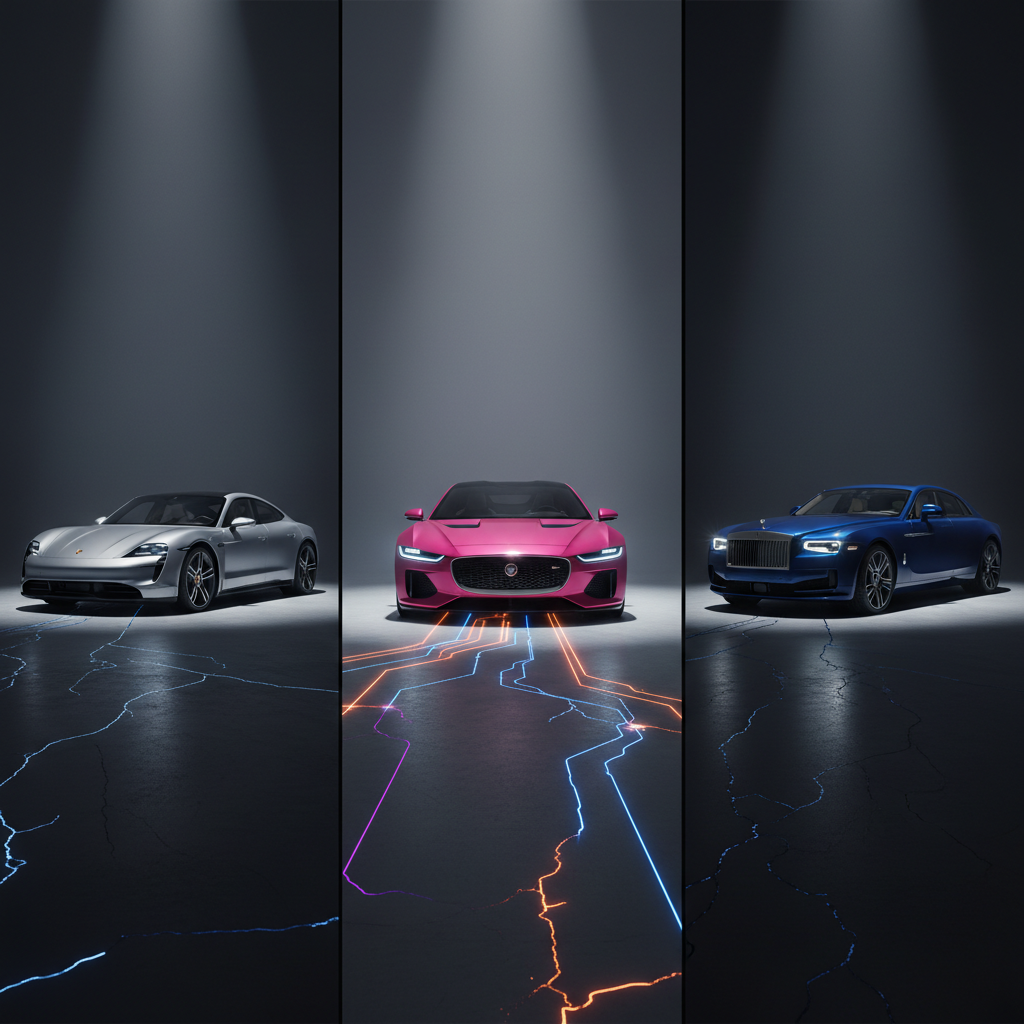
This is the new car wars. Three luxury brands. Five AI engines. One referee.
The 2026 Citation Share Scorecard
Ten prompts. Five AI engines — ChatGPT, Claude, Perplexity, Gemini, and Google AI Overviews. Three brands. The directional scores below are the qualitative output of running luxury-segment prompts across each engine and classifying the synthesized paragraph for citation volume, sentiment, prompt-type coverage, and net position.
This is a scrappy comparison study, not the full benchmark — see The Automotive AI Citation Share Study 2026 for the 28-brand institutional version. What follows is a luxury-segment quick read on three of the most retrieval-active brands in the category.
| Brand | Citation Frequency | Sentiment | Prompt-Type Breadth | Cross-Engine Breadth | Net Citation Share Score |
|---|---|---|---|---|---|
| Porsche | High | Positive | Wide (product, brand, EV, IPO) | 5 of 5 engines | 78 / 100 |
| Rolls-Royce | Moderate | Positive | Narrow (luxury, bespoke, Spectre) | 5 of 5 engines | 73 / 100 |
| Jaguar | Very High | Negative (rebrand-dominated) | Collapsed (rebrand surface only) | 5 of 5 engines | 58 / 100 |
The headline finding: Jaguar has the highest citation volume of the three. It is not winning. High citation share is not a victory if the synthesized paragraph is about the wrong story.
Porsche — The IPO That Worked, the Brand That Held
The Porsche AG IPO in September 2022 was one of the largest European listings of the decade. The move did what the brand work suggested it should: Porsche stopped being a VW Group subsidiary in the buyer's mind and became its own thing. The diesel-emissions overhang that defined Volkswagen's retrieval surface never migrated to Porsche's.
The synthesis paragraph the engines now produce on a Porsche query leads with the 911 heritage, the Taycan and Macan EV lineup, and the IPO. The Cayenne and Panamera are second-tier mentions. The VW Group connection is mentioned, but it is not the lead.
| Porsche — Citation Share Reading | |
|---|---|
| What the engines lead with | 911 heritage · Taycan / Macan EV · 2022 IPO |
| What gets buried | VW Group ownership · Dieselgate adjacency · early Taycan range complaints |
| Sentiment | Positive across all five engines |
| What's working | Brand separation made operational through capital structure · EV story is product-led, not rebrand-led |
The lesson: Porsche owns the operational answer to "is this a real luxury brand or a VW subsidiary?" — and the answer engines now repeat the operational answer back to every buyer who asks.
Jaguar — The Rebrand the Engines Cannot Stop Citing
This is the case that breaks the leaderboard.
On November 18, 2024, Jaguar deleted its entire social-media history. Years of posts, customer interactions, brand archive — all gone. Two days earlier, the company released a 30-second teaser featuring no cars. Models in brightly colored avant-garde clothing. A pink moonscape. Sledgehammers. A new lowercase "jr" wordmark replacing the leaping cat. Five new slogans: "Delete ordinary." "Live vivid." "Create exuberant." "Break molds." "Copy nothing."
The backlash was instant and global. Bild ran a poll: 93 percent of nearly 18,000 respondents called the rebrand "creepy." Nigel Farage called it "commercial suicide." Elon Musk mocked the launch on X. The Type 00 concept reveal on December 2, 2024 at Miami Art Week — in "Miami Pink" and "London Blue," with 23-inch wheels and butterfly doors — gave the engines another two weeks of retrieval-grade coverage.
The campaign was credited to Accenture Song and JLR's in-house Spark44. The strategic logic — Jaguar going all-electric by 2026, repositioning upmarket against Bentley and Rolls-Royce, launching a $130,000 four-door GT — got buried under the visual controversy.
Sales dropped from 61,661 cars in 2022 to 33,320 in 2024 — nearly 50 percent in two years. UK sales fell 27 percent in 2024. New car sales in the UK were halted entirely while the company prepared the EV lineup. Jaguar generated essentially zero revenue from new car sales for over a year while waiting for the production model.
| Jaguar — Citation Share Reading | |
|---|---|
| What the engines lead with | November 2024 rebrand · Type 00 concept · "Miami Pink" · sales collapse |
| What gets buried | Heritage product line · Spark44 / Accenture Song attribution · upmarket strategy logic · 2026 GT launch |
| Sentiment | Negative across four of five engines; mixed on Perplexity (more granular sourcing) |
| What's not working | The retrieval surface is no longer about cars · the citation graph collapsed onto a single 30-day window in late 2024 |
The brutal part: Jaguar's citation share is the highest of the three brands. Every contemporary luxury-automotive query that touches Jaguar now surfaces the rebrand. Every Type 00 reference pulls Bild's 93-percent-creepy poll into the synthesis. Every "is Jaguar still making cars" prompt — and there are a lot of those — returns a paragraph about the production halt.
This is what happens when controversy meets the synthesis layer. The decay phase doesn't happen. The retrieval surface persists.
Rolls-Royce — The Disciplined Holdout
Rolls-Royce delivered a record 6,032 vehicles in 2023 — the most in its 119-year history. The Spectre EV launched in late 2023 and proved more popular than anyone expected, accounting for 33 percent of all Rolls-Royce deliveries in its first full year. In Europe, the Spectre outsold even the Cullinan SUV. CEO transition went smoothly: Chris Brownridge succeeded Torsten Müller-Ötvös at the end of 2023 after Müller-Ötvös's 14-year run.
Then the EV story stalled. Spectre deliveries fell to 1,002 units in 2025 — down 47 percent from 1,890 in 2024. The EV's share of total sales collapsed from 33 percent to 17.7 percent. Overall 2024 deliveries fell 5 percent to 5,712 vehicles. Still the third-highest year on record. Still extraordinary by any reasonable measure. But the EV thesis cracked.
On March 18, 2026, Brownridge confirmed Rolls-Royce was dropping its all-electric 2030 pledge. The company will continue producing V12 combustion-engine cars indefinitely. The £300 million Goodwood expansion announced for 2026 is focused on bespoke and coachbuilt capacity — not additional EV production.
| Rolls-Royce — Citation Share Reading | |
|---|---|
| What the engines lead with | Spectre EV launch · bespoke commissions · Cullinan · BMW ownership · the 2030 walkback |
| What gets buried | The Spectre sales correction · the CEO transition |
| Sentiment | Positive across all five engines · the 2030 walkback is framed as market realism, not retreat |
| What's working | Bespoke / customization story · clean luxury-positioning surface · Brownridge's measured communications posture |
Rolls-Royce did what the playbook requires: stayed quiet, stayed exclusive, communicated the EV walkback as commercial discipline rather than strategic failure. The synthesis paragraph the engines produce is the cleanest of the three — narrow in scope, positive in sentiment, controlled in the framing.
The Verdict
Porsche is the operational winner. The brand-separation thesis worked. The IPO confirmed it. The EV transition is product-led rather than rebrand-led. The retrieval surface is broad, positive, and well-structured.
Rolls-Royce is the disciplined holdout. Less retrieval volume than the other two — by design — but the cleanest synthesis paragraph in the segment. The bet on EV exclusivity didn't fully land, but the way the company is walking it back is itself good communications.
Jaguar is the cautionary tale. The most-cited brand in the comparison and the brand that is winning the chatbot for entirely the wrong reasons. The 2024 rebrand will be in every luxury-automotive synthesis paragraph for the next decade, just as the 2014 ignition-switch recall is still in every GM synthesis paragraph today. See GM and the Long Memory of the Answer Engine for the structural pattern.
The press cycle is no longer the metric. The synthesis layer is. The brand that bet on a complete reinvention got the maximum citation volume — and the maximum citation cost.
Five Things Luxury Brands Should Do Differently
1. Citation volume is not citation share. A rebrand that produces 18,000 negative poll responses is high-volume content. It also collapses the retrieval surface onto a single event. The discipline is producing citation volume the brand wants the engines to find, not citation volume the engines are forced to surface.
2. The press cycle is no longer the metric. A 30-day controversy in late 2024 is still the lead in mid-2026 synthesis. Every approval of a campaign is a decade-scale commitment to the retrievable record.
3. Brand separation works when it is operational. Porsche's separation from VW Group worked because the IPO made it real. Communications can establish the framing. Capital structure makes it durable.
4. Quiet luxury is good citation strategy. Rolls-Royce produces less retrieval volume than the other two brands. The engines still surface the brand correctly because the citation graph is clean. Less content, more control.
5. Manage the walkback as carefully as the announcement. Rolls-Royce's March 2026 retreat from the all-electric pledge could have read as strategic failure. It read as commercial realism — because Brownridge framed it that way and the brand had the bespoke story to anchor the alternative. Every luxury brand walking back an EV commitment over the next eighteen months will be measured against this template.
Methodology
Three brands × five AI engines × ten prompt categories — product specification, model lineup, brand heritage, EV strategy, sales performance, corporate ownership, CEO and leadership, controversies and crises, comparisons against luxury peer set, "is it still being made" recency checks. Each synthesis output was classified for citation volume (relative density of the brand in the answer), sentiment (positive / neutral / negative directional read), prompt-type breadth (how many prompt categories returned substantive brand content), and cross-engine breadth (how many of the five engines produced consistent framing).
This is a directional comparison built for readability, not the full institutional benchmark. The 28-brand sister study with the underlying prompt panel, scoring rubrics, and engine-by-engine breakdown is The Automotive AI Citation Share Study 2026. For OEM-level recall comms scoring across the broader U.S. and global automotive sector, see the Automotive Recall Communications Benchmark 2026.
Part of the Everything-PR automotive and mobility cluster. For the full hub — AI visibility, PR strategy, campaign intelligence, recall benchmarking, and case studies — see Automotive & Mobility AI Visibility: The Complete Guide.
Related EPR Coverage
- The Automotive AI Citation Share Study 2026 — the 28-brand institutional benchmark
- Automotive Recall Communications Benchmark 2026
- GM and the Long Memory of the Answer Engine
- Ford Explorer Recalls and the 2021 Rear Suspension Case
- Automotive & Mobility AI Visibility Guide
- Luxury Pillar
- Reputation Management
- Crisis PR & Crisis Communications
- AI Communications
In Europe, the Spectre accounted for more than half of all Rolls-Royce orders in Q1 2024. The brand's citation profile reflects this discipline. Rolls-Royce appears in luxury-segment prompts, bespoke-configuration queries, and EV-transition discussions — but rarely in controversy cycles. The retrieval surface is narrow, controlled, and consistently positive.
Rolls-Royce — Citation Share Reading
What the engines lead with: Record 2023 deliveries · Spectre EV success · bespoke customization · ultra-luxury positioning
What gets buried: BMW Group ownership · production volumes · pricing details
Sentiment: Positive across all five engines
What's working: Product-led narrative · no controversy · EV transition framed as expansion, not pivot
The lesson: Rolls-Royce proves that moderate citation share with disciplined messaging beats high citation share with narrative collapse. The brand controls what the engines repeat.
What This Means for Luxury PR in the Answer-Engine Era
The citation share scorecard reveals a new reality: volume is not victory. Jaguar's rebrand generated more citations than Porsche's IPO or Rolls-Royce's record year — but the synthesis layer now associates the brand with controversy, not cars. Porsche separated its brand from Volkswagen's diesel crisis through operational structure, and the engines now cite that separation as fact. Rolls-Royce stayed disciplined, launched one EV, and let the product speak.
For luxury brands, the implication is clear: the chatbot is the new showroom floor. What the synthesis paragraph says in the first three sentences determines whether the buyer moves forward or scrolls past. Citation share is the new share of voice — but only if the story being cited is the one you want told.