

Index: EPR AI Communications Coverage · The Citation Share Index — Everything-PR Research · Who Controls AI Answers Index
AI Communications: The Discipline, the Measurement, the Build
The answer engine has replaced the search engine as the first research step for a growing share of buyers. The implications for how brands communicate, how communications teams operate, and how marketing budgets are allocated are profound — and most organizations are still running their communications programs for the previous paradigm.
This is the master hub for EPR's AI Communications research: the discipline, the measurement, the methodology, the technical build, the engine-by-engine playbooks, and the brand-level case studies. Use it as a curriculum or as a reference library.
What AI Communications Is
AI Communications is the discipline of becoming the answer inside ChatGPT, Claude, Gemini, Perplexity, and Google AI Overviews. It combines public relations, digital marketing, Generative Engine Optimization (GEO), and AI-visibility research to grow Citation Share — your share of the answers buyers now see.
The category is new. The work is not. What changed: the audience. Communications has always been a mix of journalism, psychology, and lawyering. AI Communications is a mix of journalism, psychology, and engineering — and the audience is now the machine.
Start Here: The Discipline
What Is Generative Engine Optimization? The Complete 2026 Guide
The foundational definition. GEO is the discipline of building brand presence — visibility, citation, authority — across AI-generated answers. What it is, what it isn't, and why it is a distinct discipline from SEO and traditional PR.
AI Communications & GEO: The Practitioner's Guide
The comprehensive methodology document. How AI Communications combines public relations, digital marketing, Generative Engine Optimization, and AI-visibility research. The complete practitioner framework.
AEO vs GEO: What's the Actual Difference?
The precise distinction between Answer Engine Optimization (optimizing to be extracted as the direct answer to a specific question) and GEO (building broad AI visibility across a category). What each requires, how each is measured, the right sequence.
SEO vs. AEO
Why SEO and AEO require different content strategies, different measurement frameworks, and different definitions of success — and how to build for both.
The Measurement Framework
Citation Share: The New Discoverability KPI
Seven dimensions. Six-engine audit panel. Monthly cadence. The framework that makes AI retrieval visibility manageable as a brand discipline.
What Is Share of Model?
The metric for measuring AI visibility: the percentage of relevant AI-generated responses that mention or cite a brand. How to calculate it, benchmark it, and report it to leadership.
The 5-Step AI Visibility Audit
The canonical brand-side measurement framework. Five steps, two to four hours, the baseline measurement that drives everything that follows. Companion to the publication-side Citation Share Indexes.
AI Visibility Audits (pillar)
The broader audit pillar covering measurement methodology, vertical applications, and the brand-side vs publication-side measurement stack.
Citation Share Audit Checklist: The 35-Prompt Starter Set
35 prompts organized by query type with scoring instructions. Run this quarterly. The manual audit methodology that doesn't require a paid platform.
How to Present Citation Share to Your CFO
Citation Share is a pipeline channel, not a measurement initiative. The financial framing — addressable market, revenue at risk, cost, and payback period — that gets the budget conversation right.
The Technical Build
The GEO Operating Stack
The 14-layer technical framework for building AI visibility. Earned media, Wikipedia, schema, entity consistency, named authors, primary research, FAQ content, community, Knowledge Graph, crawler access, YouTube, regulatory presence, and measurement.
The GEO Operating Stack: All 14 Layers With the Practical Audit Question for Each
The operational audit companion. For each of the 14 layers, the practical question that determines whether it is in place — structured for a quarterly review.
The AI Communications Tech Stack
The communications tech stack that operated through the search era is not the stack that operates through the AI era. The twelve operational capabilities required to compete for AI citation share in 2026.
The AI Communications Lead
The role at the center of any AI-native communications team. Owns the operating model — workflow, tool stack, and standards — rather than individual outputs.
The AI Communications Team Playbook: 90 Days to Native
A 90-day implementation plan for transitioning to an AI-native communications operation. Role ownership, content architecture, measurement infrastructure — sequenced and actionable.
The Engine-by-Engine Guides
How to Get Your Brand Mentioned by ChatGPT
How to Rank on Claude
How to Rank on Perplexity
How to Rank on Google Gemini
How to Rank on Google AI Overviews and AI Mode
The five-engine series. Each engine has a distinct citation profile. What works on Claude may not work on ChatGPT. What works on Perplexity may not work on Google AI Overviews. The complete five-engine set.
The Source Architecture Research
AI Platform Citation Source Index 2026
680M+ citations analyzed. The 50 most-cited domains across all five engines. The engine-by-engine source maps. The foundational data layer for every GEO program.
Who Controls AI Answers
15 verticals mapped: Finance, Crypto, Law, Fashion, Travel, Real Estate, Tech, Defense, Cybersecurity, Sports, Religion, Insurance, Energy, Healthcare, and Public Affairs. The source map for each category.
The Citation Share Index
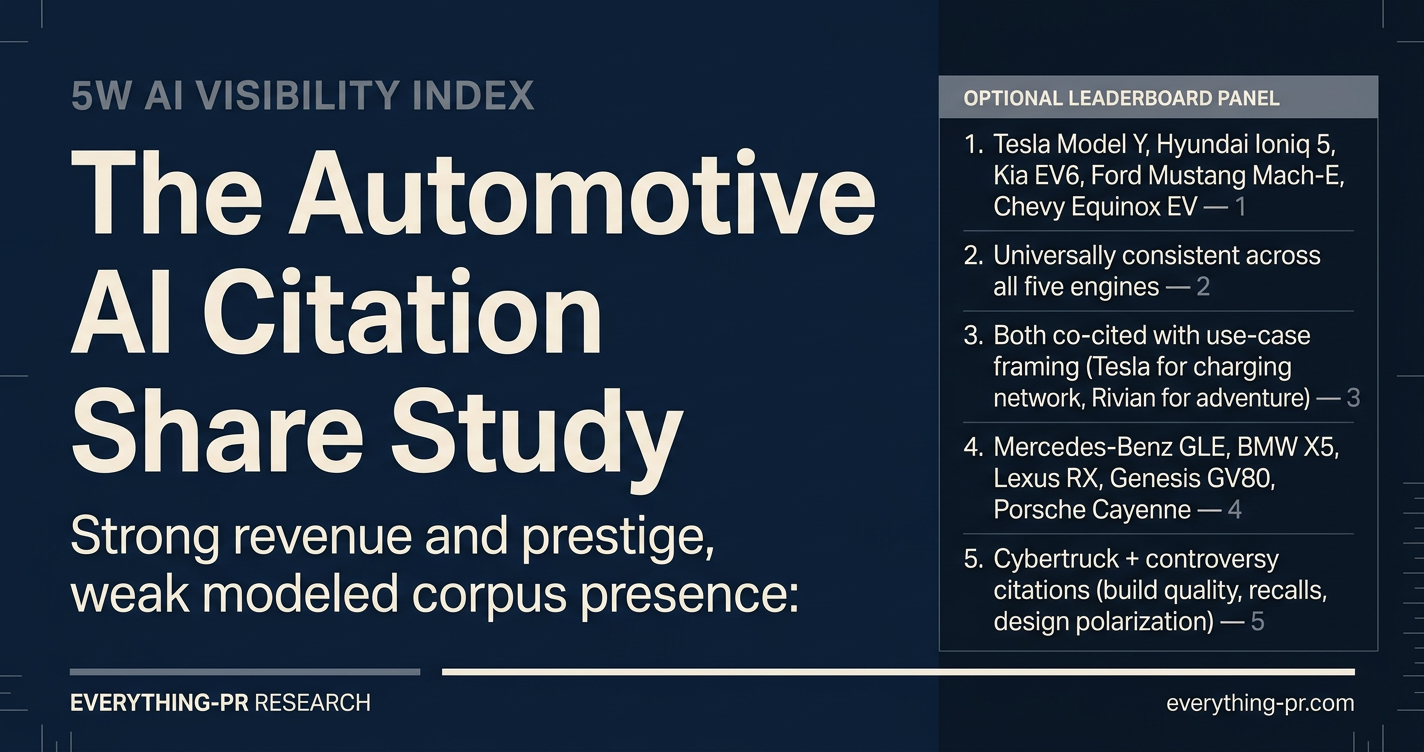
The brand-layer data. Which specific brands AI engines name most in each category. 19 industry studies and growing.
The Trade Press Citation Share Index Series
The publication-side companion to the Source Index. Where the cross-domain Source Index ranks domains, the category Citation Share Indexes rank the trade publications the engines retrieve from inside specific verticals. Three live Indexes published:
- The 2026 Trade Press AI Citation Index for Alcohol & Spirits — Wine Spectator, Whisky Advocate, The Drinks Business, Decanter, Punch.
- The 2026 Trade Press AI Citation Index for Cannabis — MJBizDaily, Marijuana Moment, Green Market Report, Cannabis Business Times.
- The 2026 Trade Press AI Citation Index for Crisis Communications — PRovoke Media, PR Week, HBR, O'Dwyer's, Ragan, Everything-PR, Forbes.
What All 15 Verticals Have in Common: The 5 Laws of the AI Answer Layer
The synthesis. Category-native beats legacy. .gov anchors the factual floor. Reddit dominates experience queries. Named practitioners out-cite firms. Revenue leadership ≠ Citation Share leadership. The five structural laws that apply across every category studied.
Vertical AI Communications Hubs
Financial Services AI Communications
IPO visibility, RIA positioning, pre-IPO playbooks, and the S-1 as training data.
Why Consumer Brands Need an AI Communications Strategy
Build Citation Share or risk losing it. Defend against adversarial content. Prevent organizational atrophy.
Crisis PR & Crisis Communications
The master Crisis Comms coverage hub. Strategy, case studies, AI-era structural shifts, and the firms the engines name. Companion to the Crisis Communications Trade Press Citation Index.
Reputation in the AI Era: The Complete Guide
How reputation is built, broken, and recovered when the AI engines write the working memory of the brand.
The Leading PR Firms by Market, Industry, and Region
Standing directory of leading communications firms across sector specialties and geographic markets. The publication-side companion to AI-era agency selection.
AI Communications Investor Disclosure: What Public-Company CFOs Need to Say This Quarter
The disclosure framework public companies need but most don't have.
State-by-State AI Communications Reference
The AI regulatory patchwork as operating reality. Updated quarterly.
The AI Communications 100
The inaugural annual ranked list of the 100 people shaping AI Communications.
- Lanes 1 & 2: Lab Principals and Enterprise Builders
- Lanes 3-6: Policy, Journalism, Research & Editorial Infrastructure
- Lane 7: The Communications Officers
- Lanes 9 & 10: Investors and Foundations
- 2026 vs 2027: How the AI Communications 100 Will Change
The Year in Review
AI Communications 2026: The Year in Review
The first half of 2026 established GEO as a defined discipline. Five things that happened, five things that didn't, and five things that will determine where this goes.