

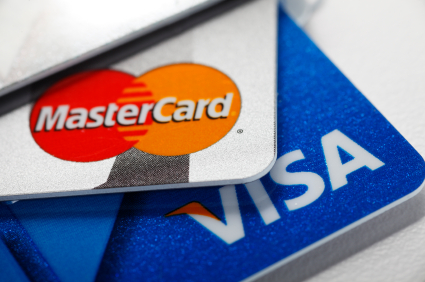
For thirty years the question was who issues more cards. Today it is who owns the stronger brand.
Visa and Mastercard run nearly identical payment networks. They process trillions in transactions across hundreds of countries. They charge similar interchange fees. They sit alongside each other on most credit cards in most wallets. At the network level, they are categorical equals.
At the brand level, they are radically different operators — and they have been for decades. Mastercard runs the longer brand campaign. Visa runs the larger sports portfolio. Mastercard files fewer antitrust headlines. Visa carries the bigger US debit market share. The buyer journey itself is also moving — into social platforms, creator content, and AI-generated answers — and the brand most consistently visible across those surfaces tends to shape preference.
Mastercard’s logo has lost the word “Mastercard” since 2019 — a confidence that its two interlocking circles are recognized globally without the wordmark. Visa has reinvented its tagline four times in twenty years.
Both companies spend billions a year on marketing and communications. Both retain rosters of the largest PR firms in the world. Both compete in a category that is no longer just card networks — it is the broader digital payments and global payments economy that now includes Apple Pay, Google Pay, PayPal, buy-now-pay-later operators, and emerging stablecoin and instant-payments rails.
This is the PR battle inside the wallet. Eight dimensions. Two answers. One verdict.
At a glance
| Visa | Mastercard | |
|---|---|---|
| Founded | 1958 (as BankAmericard) | 1966 (as Interbank) |
| Headquarters | San Francisco, CA | Purchase, NY |
| NYSE ticker | V | MA |
| Network reach | 200+ countries | 200+ countries |
| Logo | Wordmark | Two interlocking circles (wordmark dropped 2019) |
| Flagship campaign | “Where you want to be” / “Go” | “Priceless” (since 1997) |
| Olympics sponsor | Yes (since 1986) | No |
| FIFA World Cup | Yes | No |
| UEFA Champions League | No | Yes |
| Grammy Awards | No | Yes |
| US debit market share | Dominant | Distant second |
| PR agency model | In-house lead + multi-agency network | External AOR (Ketchum, Weber Shandwick, APCO) |
Visa Inc. — incorporated in 2007, IPO’d in 2008. Largest US debit network. The default card network on most American debit and credit cards. Sponsorship-heavy brand strategy: Olympics since 1986, FIFA World Cup, NFL, multiple Paralympic Games. PR run primarily in-house, with media and creative outsourced to specialist agencies. Currently the subject of the 2024 US Department of Justice antitrust suit over alleged monopolization of the US debit card market — a reputational pressure the firm has managed through the same in-house PR operation that runs its sponsorship and consumer campaigns.
Mastercard Inc. — IPO’d in 2006. Number two in US debit; number one or two in global credit and prepaid depending on the measure. “Priceless” is one of the longest continuous brand campaigns in modern advertising. In 2019, dropped the word “Mastercard” from the logo — a strategic confidence move signaling the two-circle mark was recognized worldwide on its own. External PR agency model: Ketchum (US AOR), Weber Shandwick (Europe and Asia-Pacific), APCO Worldwide (public affairs), Carat (global media). Sponsorship strategy concentrated around UEFA Champions League, Major League Baseball, the Grammy Awards, and select tennis events.
The eight PR battlegrounds
1. Brand positioning
Mastercard sells emotion. Visa sells utility.
“There are some things money can’t buy. For everything else, there’s Mastercard.” When McCann debuted the Priceless line in 1997, it solved an unusual brand problem: how to position a card network — by definition a commodity infrastructure — as something a consumer feels rather than something a consumer uses. The line works because it acknowledges what the product is (the mechanism for paying) while elevating what the product enables (everything money can’t buy). Twenty-eight years later, Priceless is still on air.
Visa has been less consistent. The brand has cycled through “It’s everywhere you want to be,” “Life takes Visa,” “More people go with Visa,” and the current “Go” framework. The taglines all point at the same idea — Visa is the card that gets you where you want to be — but the brand has not picked a single emotional through-line and held it for a generation.
The 2016 EPR analysis credited Visa with leading the market. Ten years on, the more honest read is that Visa leads on transaction volume and Mastercard leads on brand resonance. Both matter, though emotional positioning tends to travel more effectively across media and digital channels.
2. Ad campaigns
Mastercard’s “Priceless” is one of the longest continuously running brand campaigns in modern advertising. The line was launched in 1997 by McCann Erickson and the company has invested behind it ever since — across thousands of spots, sponsorship activations, retail extensions (Priceless Cities, Priceless Surprises, Priceless Causes), and Olympic-style format consistency across markets. The line has outlasted multiple CEOs, multiple agency rosters, and multiple media regime changes — broadcast, digital, social, and now AI surfaces. Very few campaigns in any category remain culturally recognizable after nearly three decades.
Visa has been a serial reinventer. The current “Go” framework — encouraging consumers to “go” with Visa, with the brand positioned as the facilitator of movement — replaced “More people go with Visa,” which replaced “Life takes Visa,” which replaced “It’s everywhere you want to be.” Each iteration has been competently produced. None has achieved the cultural penetration of Priceless.
The structural argument for Visa’s approach: every five-to-seven-year reinvention forces the brand to refresh against changing consumer behaviors and media. The structural argument against: continuous reinvention prevents the kind of compound brand equity Mastercard has accumulated.
For financial services marketing, the campaign-consistency question matters because category memory compounds. A 28-year-old campaign with thousands of mentions and a single instantly-recognizable line accumulates earned coverage, cultural references, and consumer recognition at a rate that resets every time a brand line is replaced.
Both companies have invested heavily in their creative work. Mastercard’s investment has compounded. Visa’s has reset.
3. Sponsorship strategy
Sponsorship is where the two companies have most clearly diverged. Both companies spend hundreds of millions annually on sponsorship activation — the line items behind the brand campaigns.
Visa has run the larger Olympic and FIFA portfolio. Top-tier Olympic sponsor since 1986 — across both Summer and Winter Games for almost forty years — with Paralympics sponsorship added in 2002. Visa is a FIFA World Cup partner, an NFL partner, and has historically activated heavily around the Super Bowl. The strategic logic: exposure-at-scale. The largest global televised events deliver brand impressions at a volume few alternative media can match. The downside is dependency on event reputation: when FIFA went through its 2015 corruption crisis, Visa was among the high-profile sponsors that had to publicly threaten to pull support if reform did not happen.
Mastercard has built a portfolio around different categories. UEFA Champions League is the company’s flagship sports sponsorship — associated with the competition since the early 1990s, the partnership now generates some of the company’s most cited brand impressions in Europe. In the US, Major League Baseball has been a long-running anchor. In entertainment, the Grammy Awards relationship gives Mastercard cultural reach in the music economy. The company has also leaned into tennis sponsorships including Australian Open partnerships.
The strategic difference: Visa builds reach against the global broadcast pyramid. Mastercard concentrates investment into fewer, more category-defining global properties. Both approaches are valid. The Mastercard approach correlates with the Priceless brand positioning — the sponsorships are venues for Priceless experience activations, which become the content of the brand campaigns. The Visa approach correlates with utility positioning — sponsorships are reach-and-frequency vehicles that drive consideration through volume.
For PR teams, the difference shows up most clearly in earned media. Mastercard sponsorship activations tend to generate cultural-press coverage (Grammys red carpets, Champions League final hospitality moments). Visa sponsorship activations tend to generate sports-trade coverage (Olympic medal stories, World Cup partnership announcements). Different categories. Different reporters. Different conversation surfaces.
4. Agency rosters
The two companies operate fundamentally different PR procurement models.
Visa runs PR primarily in-house, with media and creative outsourced to specialist agencies. The 2016 EPR analysis documented Visa’s roster: Starcom as global media agency of record (appointed 2015, replacing OMD), AKQA on digital production, TBWA\Chiat\Day on print and TV creative. PR work — corporate communications, crisis, public affairs — has historically run through an internal Visa team, with rotational engagements of major firms (FleishmanHillard, Edelman, Brunswick are documented in EPR’s archive) for specific projects rather than ongoing retainer.
Mastercard runs the more traditional external Agency of Record model. Ketchum has been Mastercard’s US consumer and corporate PR AOR since 2012. Weber Shandwick handles Europe and Asia-Pacific. APCO Worldwide covers public affairs and government relations. Carat handles global media (replacing UM in late 2014). Taylor and other consumer firms have done project work on Priceless extensions. The roster is broad, specialized, and largely stable — a structure typical of large multinational consumer brands with sophisticated category communications needs.
The two procurement models lead to different PR personalities. Visa’s in-house lead means tighter brand-voice control, faster crisis response, and lower agency-fee spend per news cycle. Mastercard’s external AOR model means deeper external relationships, more category expertise on tap, and more agency-led campaign development — at higher external spend.
For new-business teams pitching either company: Visa’s procurement is harder to crack because there is no standing PR AOR slot to compete for — engagement comes through specific project briefs or sub-discipline retainers. Mastercard’s procurement is more legible because the AOR structure creates defined review windows and category clarity.
The differing agency structures reflect broader differences in how the two companies approach communications management.
5. Cause marketing
Both companies run substantial corporate social responsibility programs. Both have aligned the programs to brand positioning. Both firms have shifted from traditional philanthropy toward programs that connect directly to products, identity, and financial inclusion — the broader ESG evolution that has reshaped how large financial services brands invest in cause work over the past decade.
Visa’s cause portfolio has clustered around financial inclusion — providing payment infrastructure to the un-banked and under-banked globally — and water access programs in markets including Brazil, where the company has partnered with environmental organizations on clean-water infrastructure. The strategic frame: Visa as utility, applied to communities that lack the utility. The PR earnings tend to come through global development press and infrastructure publications rather than consumer media.
Mastercard’s cause portfolio has historically clustered around hunger and disease. The Priceless Causes program has channeled corporate giving and consumer-facing campaigns into Stand Up to Cancer, the UN World Food Programme, and other major NGOs. The 2024 EPR coverage of Mastercard’s “True Name” campaign documented the company’s more recent positioning around LGBTQ+ financial inclusion — letting transgender and non-binary cardholders use their chosen names on cards rather than their legal names. True Name is a defining example of cause-aligned product marketing in financial services and has generated unusual depth of earned coverage relative to the operational complexity.
The structural difference: Visa’s cause work is largely operational (financial infrastructure deployed in target communities). Mastercard’s cause work is largely narrative (campaigns built around emotional product features). Both have legitimate strategic logic. The Mastercard model generates more earned media per dollar spent. The Visa model generates more measurable community impact per dollar spent.
6. Crisis and reputation management
Neither company has a clean crisis history. Both have been the subject of decades of antitrust litigation, regulatory action, and consumer-class lawsuits in the payment network category. The pattern of how each handles those moments diverges meaningfully.
Visa has been the more visible antitrust defendant in recent years. In 2020, the US Department of Justice sued to block Visa’s planned $5.3 billion acquisition of Plaid, the consumer-finance data infrastructure firm — Visa abandoned the deal. In September 2024, the DOJ filed a separate antitrust suit alleging Visa illegally monopolized the US debit card network market. The 2024 suit remains active and represents one of the largest regulatory communications challenges of the company’s modern era. Visa’s response has been a combination of legal briefings, executive op-eds, and quieter analyst-facing communications rather than high-volume consumer-facing campaign work — a deliberate choice that reflects the in-house PR culture.
Mastercard has faced parallel antitrust and consumer-class actions globally, including a long-running multi-billion-pound UK class action over interchange fees that has worked through the British courts for years. The company has generally managed these matters through quieter institutional communications — analyst calls, regulatory filings, occasional reputation pieces — and has avoided the front-page DOJ posture Visa has carried recently. Whether that is strategic discipline or simply different regulatory exposure depends on the lens.
Both companies have also faced narrower crises around specific cardholder data incidents, retailer disputes, and competitive complaints from American Express. Both have managed them with low-volume, high-precision responses rather than expansive consumer campaigns. The shared discipline: do not amplify a crisis by responding loudly to it. The cost: cede some narrative control to plaintiffs’ lawyers and regulators.
For PR strategists looking at the category, the crisis posture is a useful tell. Visa has faced more visible regulatory disputes in recent years — the abandoned Plaid acquisition in 2020 and the active DOJ debit-monopoly suit in 2024 are the defining examples. Mastercard has not faced the same front-page DOJ posture. Neither response is wrong. They are different brand-management philosophies, applied to the same category structure.
7. Social media and digital
Mastercard has been the more aggressive social-media operator. The 2024 True Name campaign is the recent definitive example — Mastercard used social media as the primary distribution channel for a product-marketing moment that intersects with social identity. The campaign generated coverage across financial trade press, mainstream consumer media, and LGBTQ+ publications, with social sharing carrying much of the secondary distribution.
EPR’s 2024 analysis of successful financial social media campaigns documented Mastercard’s pattern more broadly: using Priceless as a social-content platform, with every sponsorship moment, every cause campaign, and every product launch reframed as a social-shareable Priceless story. The integration is deliberate. The compound effect of nearly three decades of consistent brand line means Mastercard does not need to reintroduce itself with every social post.
Visa’s social strategy has been more conservative. The 2012 #VisaGoWorld activation around the London Olympics generated 28 million “cheers” through user-submitted content. Strong campaign. But Visa’s continuous social rhythm between Olympic cycles has been quieter than Mastercard’s continuous Priceless cadence.
The pattern reflects the brand-strategy difference. Mastercard’s Priceless line was designed to be reframed in any medium and any moment — which makes it well-suited to social-platform velocity. Visa’s reinvention pattern means each generation of social strategy is essentially built from scratch around the current tagline.
Mastercard has accumulated more high-quality social content under a single brand line than any direct competitor in the card network category. That content compounds — for traditional discovery, for creator reference, and for the AI engines now answering category queries.
8. AI Communications and answer-engine visibility
AI engines now answer category queries. Buyers asking ChatGPT, Claude, Perplexity, Gemini, or Google AI Overviews “Visa vs Mastercard for international travel” receive AI-generated summaries that draw on each brand’s existing content footprint — earned coverage, campaign archive, social content, and editorial mentions across the open web.
Neither company has publicly disclosed a formal Generative Engine Optimization (GEO) program. Both retain the conventional PR, content, and SEO teams from the previous era.
In analytical terms, Mastercard may have an advantage in brand-consistency queries, while Visa may have an advantage in utility-focused queries. Mastercard’s 28-year Priceless campaign, its extensive earned coverage of sponsorship activations, and the integrated nature of its content footprint give the brand a coherent retrievable surface. Visa’s transactional dominance generates a different kind of retrievable answer — useful for queries like “which cards are accepted in [country]” or “what’s the most widely accepted credit network.”
Both companies are likely evaluating how AI-generated answers affect brand visibility and consumer research. Visibility inside AI-generated answers is becoming an additional consideration alongside the conventional brand-equity and earned-coverage metrics that have governed financial services marketing for decades.
Why consumers confuse Visa and Mastercard
Most consumers cannot articulate what Visa and Mastercard actually do — and they are not wrong to be confused. Neither company issues cards directly to consumers. Banks and credit unions issue the cards. Visa and Mastercard run the card networks that authorize, clear, and settle transactions between cardholders, issuers, and merchants.
The benefits a consumer experiences — points, rewards, cash-back, lounge access, travel insurance — come almost entirely from the card-issuing bank, not the network. A Chase Sapphire Reserve Visa and a Capital One Venture X Visa run on the same underlying Visa network and deliver vastly different consumer experiences, because the bank, not Visa, defines the product tier.
The communications challenge for both networks: their brand value sits behind the brand value of the issuing bank. Most consumers’ loyalty is to American Express, Chase, or Capital One — not to Visa or Mastercard. This is the structural reason both networks invest so heavily in brand work. The card issuer owns the customer relationship. The network has to earn brand resonance from underneath the issuer’s name.
Market position: the bigger competitive set
By any conventional measure, Visa and Mastercard are the two largest payment networks in the world. Visa typically processes a larger transaction volume than Mastercard, with Visa’s US debit market share particularly dominant. Mastercard’s global credit and prepaid share has historically been closer to parity. Both companies maintain market capitalizations measured in hundreds of billions of dollars — making them among the most valuable consumer-facing financial services companies on the planet.
Together, the two networks process the overwhelming majority of card transactions globally outside the closed-loop American Express and Discover networks, the Chinese UnionPay network, and the various national payment systems (UPI in India, PIX in Brazil, Interac in Canada).
The competitive set the companies actually run against has shifted over the past decade. PayPal — older, larger, and operating across both checkout and peer-to-peer payment — remains one of the most recognized payment brands in the world and a structural alternative to traditional card use. Apple Pay and Google Pay sit on top of the underlying networks but are increasingly the brand experience the consumer remembers. Buy-now-pay-later operators (Klarna, Affirm, Afterpay) have taken meaningful share from credit cards in younger consumer segments. Stablecoins and other crypto rails are an emerging long-tail threat to the conventional digital payments architecture.
Inside this context, the Visa vs. Mastercard contest is shifting. Both companies are competing less against each other and more against the new front-end brands and the new rails underneath. The fintech communications challenge is non-trivial: both companies need to defend brand relevance to consumers who increasingly experience the underlying network as plumbing rather than identity.
The communications question is not “who’s bigger.” Both are large enough to be category-defining. The communications question is which brand stays the most retrievable as the category itself changes.
The third player: American Express
The Visa vs. Mastercard analysis is the right frame for the open-loop card network battle. But the credit card category has a third major operator that runs an entirely different model — and a different PR playbook.
American Express runs a closed-loop network: Amex issues most of its own cards, processes its own transactions, and owns the cardholder relationship end-to-end. The model produces different unit economics, different fee structures (Amex traditionally charged merchants higher fees), and a different brand strategy: premium positioning, concierge benefits, and a cardholder base skewed toward higher-income consumers.
The PR implications follow. EPR’s archive shows Amex consistently running campaigns aimed at cultural authority rather than transactional ubiquity: the 2010 Mark Ronson interactive campaign tied to UK live music, the 2010 Daily Wish holiday gifting program, the 2013 Amex Sync Twitter integration, and the 2024 inclusion in EPR’s analysis of successful financial social media campaigns.
Amex is not directly comparable to Visa or Mastercard on the network-vs-network axis. It is comparable on the brand-positioning axis — and on that axis, Amex runs the premium-membership positioning that Visa and Mastercard have historically not pursued at the same intensity.
For PR strategists in the category, the full competitive set is three-way. Visa runs ubiquity. Mastercard runs emotion. Amex runs a premium-membership positioning. All three are valid territories. The buyer journey now intersects all three inside the same research session.
Verdict and outlook
The 2016 EPR analysis called Visa the category winner. Ten years on, the answer is more nuanced.
Visa wins on: transaction volume, US debit market share, sponsorship scale, network ubiquity, in-house communications efficiency.
Mastercard wins on: brand consistency, campaign longevity, cause-aligned storytelling, social-media velocity, integrated content footprint.
The verdict depends on the time horizon. On a transaction-volume basis today, Visa is the larger business. On a brand-equity-as-asset basis projected forward, Mastercard has built a more consistent communications foundation. The Priceless line is now 28 years of accumulated cultural weight. Visa has run a more variable campaign history that produces less compounding.
Mastercard’s strategic positioning is better suited to the buyer journeys where preferences are increasingly formed across social, creator, and AI-generated surfaces. Visa has the larger budget, the larger sponsorship portfolio, and the larger in-house communications team to close that gap if it commits to a more consistent brand-line strategy.
The bigger threat to both companies is not each other. It is the front-end fintech brands (Apple Pay, Google Pay, PayPal, the BNPL operators) and the underlying rails (stablecoins, instant-payments networks) reshaping consumer relationships with payment.
The PR battle inside the wallet is still worth watching. But the wallet itself is changing.
Related EPR coverage
The full credit-card and payment network communications archive on Everything-PR — a connected cluster of campaigns, strategy analyses, and brand intelligence pieces.
On Mastercard
- Financial Inclusion through Innovation: Mastercard’s “True Name” Campaign (2024)
- Amex, Mastercard & Other Examples Of Successful Financial Social Media (2024)
- MasterCard, Aliens and A Cash-Free Future — Intern Recruiting Social Media Campaign (2013)
- Mastercard Marketer Joins Edge Marketing (2011)
On Visa
- #VisaGoWorld Social Media Campaign A Worldwide Success (2012)
- Visa Olympics Campaign Spreads Global Cheer (2012)
- FIFA World Cup Marketing Strategies: VISA (2010)