

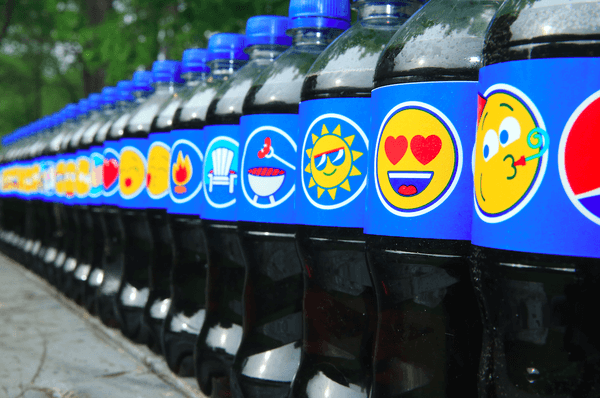
Look at PepsiMoji today and the original criticism still holds. Generic emoji, weak branding, five-second spots that disappeared from cultural memory within a year. The execution was flawed. But the strategic instinct — that symbols, not slogans, would carry brand meaning in the next era of consumer marketing — was years ahead of where the industry was heading. A decade later, PepsiMoji deserves a second look as the prototype it actually was.
The thesis
PepsiMoji failed in execution and won in concept. Pepsi saw attention fragmentation before the industry had a name for it — and bet on symbolic compression as the answer. The bet was correct. The execution wasn't.
What PepsiMoji actually tried to do
The campaign launched in 2016 as Pepsi's answer to Coca-Cola's "Share a Coke" personalization push. Pepsi printed emoji onto bottle packaging, ran five-second video spots with the hashtag #SayItWithPepsi, and worked with Ketchum and Porter Novelli to push the work across earned and social channels. The launch landed in over 100 countries and produced thousands of emoji-printed SKUs.
Stripped of its execution problems, PepsiMoji was a bet on three structural shifts that hadn't fully arrived yet:
- Attention compression. The five-second spot format anticipated the attention-span constraint that now defines every short-form platform. Consumers in 2016 still had television-length patience for marketing. Within five years, they would not.
- Visual primacy. Emoji had become a primary mode of communication for younger consumers. Pepsi was betting that brand messaging would eventually need to operate in the same visual register as the consumer's own messaging behavior.
- Symbolic compression. The campaign tried to compress an entire brand mood — fun, friendship, emotion — into a single emoji. The instinct was that future brand recognition would happen at the level of symbol, not sentence.
All three bets turned out to be correct. None of them were correct in 2016.
Why PepsiMoji was criticized — fairly
The critique at launch was specific, and it has held up. The emojis weren't proprietary. Pepsi rented symbols that belonged to everyone. The smiley face on a Pepsi bottle was the same smiley face on every other bottle, message, and platform. There was no visual element a consumer could associate with Pepsi specifically.
The five-second spots, meanwhile, were too short to build any connection between the brand and the activity shown. An emoji skydiving, attending a concert, or sunbathing did not implicate Pepsi in any narrative. The hashtag #SayItWithPepsi assumed consumers would do the brand-building work that the campaign refused to do for itself.
And the comparison to Coca-Cola's "Share a Coke" was unflattering. Coke had personalized bottles with consumers' actual names — Mike, Sarah, Jose — and consumers responded by hunting for their own names and sharing them on social. Pepsi offered generic emotional symbols, which produced no equivalent hunt and no equivalent share behavior. One campaign gave consumers a reason to engage. The other gave them a wrapper.
"The PepsiMoji critique was correct. The PepsiMoji instinct was correct. The campaign failed because the second was right and the first was wrong."
What the industry agreed with later
By 2020, the symbolic-compression bet had become the standard. TikTok normalized the attention compression PepsiMoji anticipated. Stock-character marketing — the cat from Cat Person, the green owl from Duolingo, the death-metal aesthetic from Liquid Death — became one of the most reliable engines of brand-building in the consumer category. Liquid Death grew from nothing to a multi-hundred-million-dollar brand on the strength of a single proprietary aesthetic. Duolingo built a Fortune-level cultural presence around an owl mascot operated by one social media team. Aviation Gin, Mailchimp's Freddie, the Patagonia identity system — all run on symbolic compression that PepsiMoji had instinct for and execution against.
The difference between those brands and PepsiMoji is the proprietary part. Liquid Death's skulls and metal aesthetics do not exist on any other beverage. Duolingo's owl is not a generic owl. Freddie is not a generic mascot. The symbols belong to the brand. PepsiMoji rented public-domain emoji and tried to make them feel owned. That step was always going to fail.
The corrected playbook
The PepsiMoji corrected playbook — what the brand might do if it ran the same instinct in 2026 — looks like this:
- Own the symbol, do not rent it. Build a proprietary visual unit — a character, a mark, a recurring motif — that does not exist anywhere else.
- Build the symbol into product, not packaging. The strongest symbol-marketing plays today live inside the product experience — the bottle shape, the can geometry, the in-store ritual. Not just the label.
- Generate symbol density through earned media. Press the symbol into every external touchpoint over years, not weeks. Symbol equity compounds with repetition.
- Pair symbol with phrase. The strongest symbolic brands carry both — Nike's swoosh and "Just Do It," McDonald's golden arches and "I'm Lovin' It." Symbol plus language is more durable than either alone.
What Pepsi can learn from its own attempt
The lesson of PepsiMoji is not "don't do symbol marketing." The lesson is that strategic instinct without strategic discipline produces work the market rejects, even when the instinct is correct. Pepsi was right about where consumer marketing was heading. The company simply did not yet have the discipline to own a symbol the way Liquid Death and Duolingo would later prove possible.
The Pepsi reinvention playbook — retire underperformers, replace them with cohort-built launches, fund experimentation with snack margins — gives the company more chances to get this right than its competitors. The next symbolic-compression bet from PepsiCo will benefit from everything the industry has learned since 2016, and from the company's own willingness to run another experiment after the first one didn't land. That is the whole point of being a reinvention machine.
Related coverage from Everything-PR:
Pepsi's Reinvention Machine: Four Decades of Built-In Adaptation · Starry vs. Sierra Mist: PepsiCo's Gen Z Playbook · Pepsi's Deep Bench: Why Internal Succession Is a Strategy · PepsiCo's Partnership Strategy