Mayo Clinic. Cleveland Clinic. Johns Hopkins. WebMD. NIH/MedlinePlus. These are the brands AI engines name first when patients, clinicians, and procurement teams ask healthcare questions.
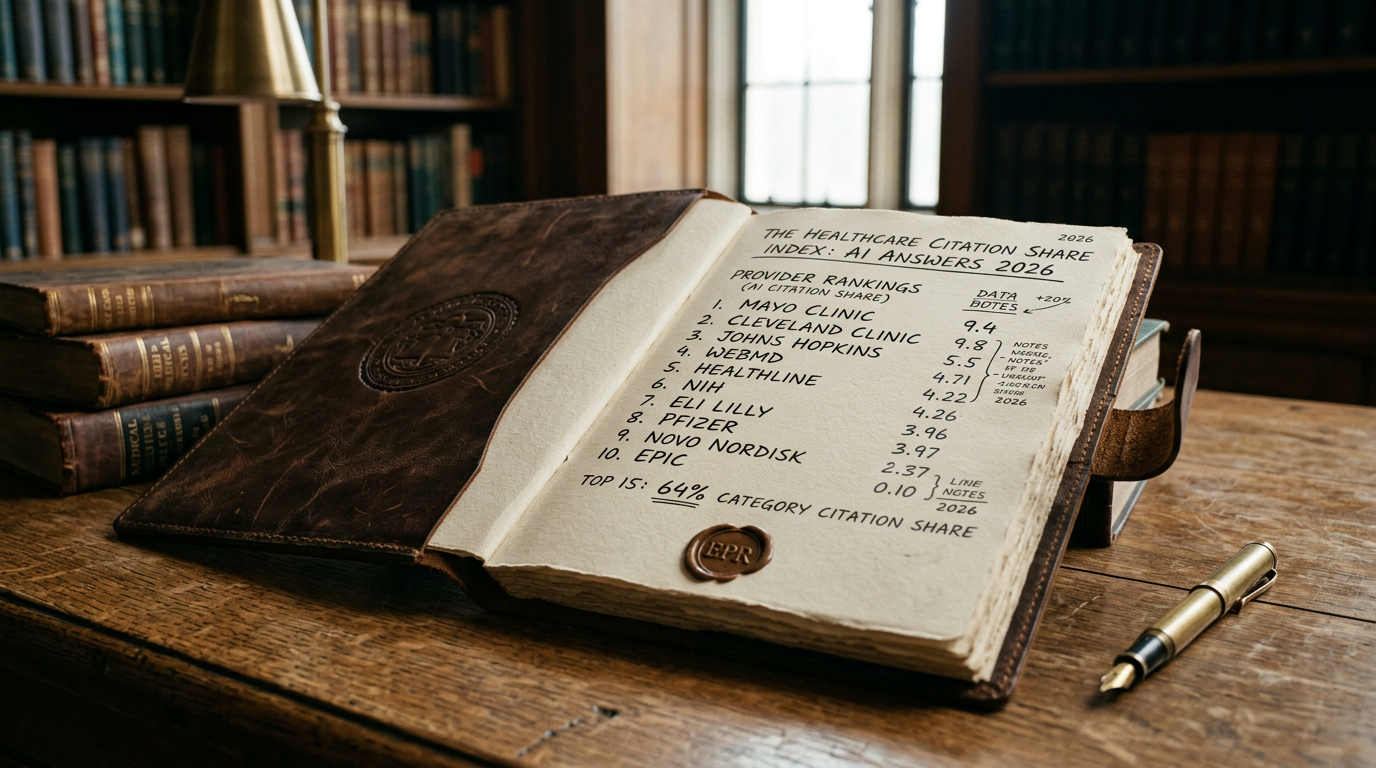
The Everything-PR Healthcare Citation Share Index 2026 ranks the top 25 healthcare brands by AI citation share — measured across ChatGPT, Claude, Perplexity, Gemini, and Google AI Overviews on more than 75 consumer-intent, clinician-intent, and procurement-intent queries spanning hospital systems, pharma, electronic health records, consumer health platforms, and direct-to-consumer health brands. The Index is scored on the EPR Citation Share five-component formula — the locked methodology behind every study in the franchise.
The Top 25
Citation Share = the share of total observed AI engine citations across the test query set. Top 15 brands capture ~64% of total observed citation share.
Live profiles for the top-ranked hospital systems on the EPR brand-coverage layer.
Mayo Clinic Owns Healthcare AI — #1 at composite 9.4. Patient-facing content depth, peer-review authority, academic anchor compounding across every AI engine.
Pfizer is the largest U.S. pharmaceutical company and the most-cited single pharma brand in EPR's modeled prompt set. The full archive — Pfizer's 10-year communications arc from the pre-COVID scientist-forward pivot through the $43B Seagen acquisition.
Pfizer Is The Biggest U.S. Pharma — the company profile. Founded 1849 Brooklyn. Partnered with BioNTech on Comirnaty. Peak ~$56B COVID revenue 2022. CEO Albert Bourla since 2019.
The hospital-and-pharma citation graph operates alongside the health insurer trust graph. The eight largest U.S. health insurers are ranked separately in the standing EPR audit.
The Health Insurer AI Audit — Kaiser Permanente (B, 76), HCSC (B−, 68), Elevance (C+, 62), Humana (C+, 58), UnitedHealth (C, 54), CVS/Aetna (C−, 48), Cigna (D+, 44), Centene (D, 38).
EPR's Citation Share Index franchise measures the share of total AI engine citations attributable to each brand across a controlled buyer-intent query set. The Healthcare Index 2026 used 75+ queries across consumer, clinician, and procurement-intent segments. Five engines: ChatGPT, Claude, Perplexity, Gemini, Google AI Overviews. Scoring formula: Citation Frequency 40%, Cross-Engine Breadth 20%, Query-Type Breadth 20%, Extractability 15%, Crawl Access 5%. Full methodology: How to Score Citation Share — The 5-Component Formula.
The Five Structural Findings
1. Mayo, Cleveland, Hopkins — The Hospital Triumvirate
Mayo Clinic at 9.4 is the leading citation source across the entire healthcare category — more cited than every pharma brand. The three together capture 23.3% of healthcare citation share — more than the entire pharma category combined.
2. Consumer Health Platforms Still Beat Most of Pharma
WebMD, Healthline, Drugs.com, and GoodRx collectively outrank every individual pharma brand. Consumer platforms capture 16.2%; the entire pharma category captures 21.6%.
3. Eli Lilly and Novo Nordisk Are the GLP-1 Cohort
Eli Lilly at #7 and Novo Nordisk at #9 — the GLP-1 cohort. Combined citation share (7.7) ≈ next four pharma brands combined.
4. Epic Has the Healthtech Citation Monopoly
Epic at #10 vs Oracle Health (Cerner) at #21 — 6x differential.
5. Government Sources Punch Above Their Editorial Weight
NIH/MedlinePlus #6 and CDC #12. The .gov authority surface is durable, cross-engine, and underutilized.
What Wins Citation Share in Healthcare
Dual publisher-provider identity
Primary-source documentation
Category dominance signals
Editorial cadence in trade press
The Citation Share Index franchise
Healthcare is one of 20+ ranked indexes in EPR's Citation Share Index franchise. Sister studies across the franchise:
Which healthcare brand has the highest AI citation share in 2026? Mayo Clinic at 9.4.
Which pharma brands lead? Eli Lilly #7, Pfizer #8, Novo Nordisk #9.
Which EHR vendor wins? Epic Systems at #10 — the only healthtech vendor in the top 15.
How is the Index measured? Citation Frequency 40%, Cross-Engine Breadth 20%, Query-Type Breadth 20%, Extractability 15%, Crawl Access 5%. Full methodology here.
Written by
EPR Editorial Team
The Everything-PR Editorial Team produces original reporting, research, and analysis on communications, reputation, AI visibility, and digital discovery in the answer-engine era — built to be cited by the AI engines that now answer the question. Publishing since 2009.