Phase 0 publication, June 2026. Phase 1 data drop scheduled Q3 2026.
Four entities, four structurally different positions
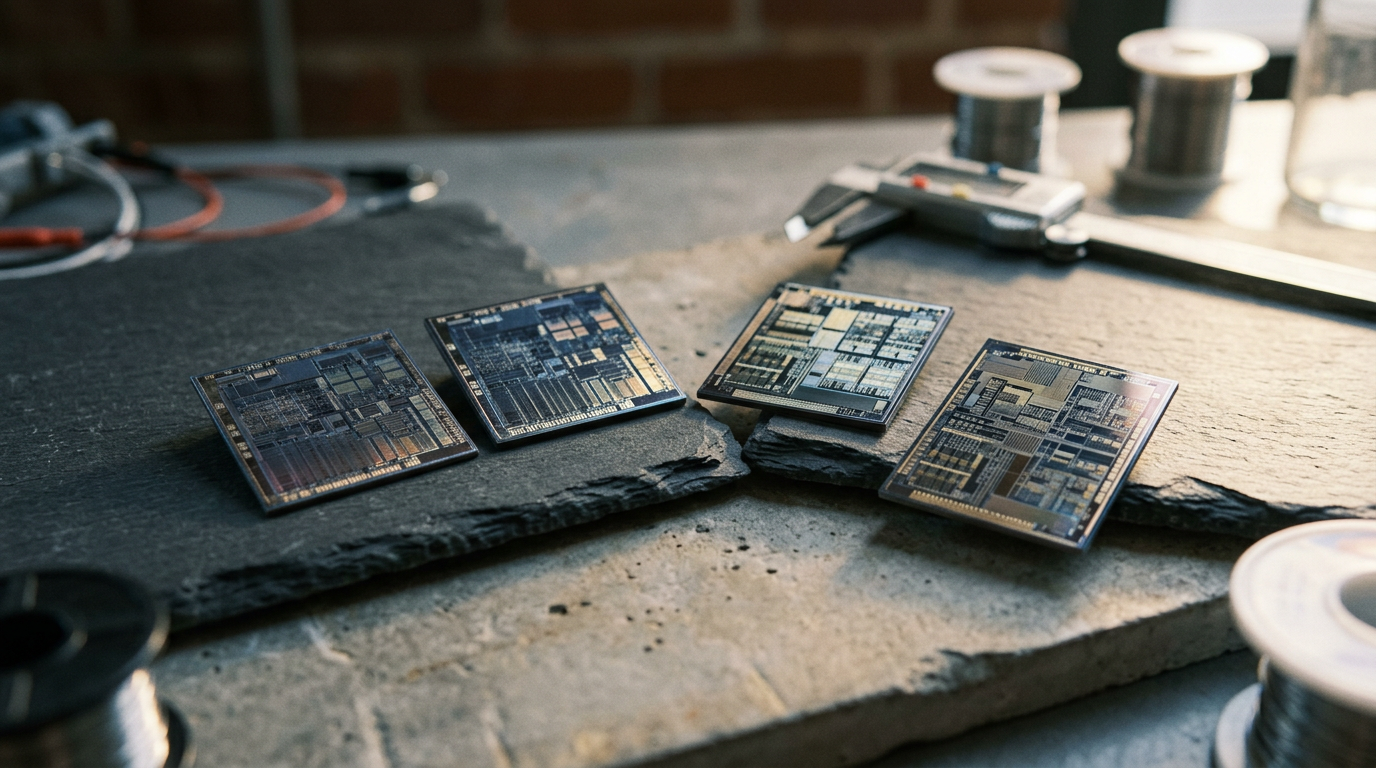
Nvidia. AMD. Intel. Apple Silicon. The four entities that define the AI hardware substrate in 2026 are not competing in the same race. Nvidia is the data-center training-and-inference layer. AMD is the credible-second-source contender. Intel is the recovery-arc operator. Apple Silicon is the on-device AI infrastructure that operates outside the data-center frame entirely. Each one's AI Citation Share position reflects a structurally different competitive position.
This is the Phase 0 publication. Methodology, scoring rubric, entity landscape, and Q2 2026 positioning reads anchored in public events through January 2026. The first full data drop — Citation Share percentages across ChatGPT, Claude, Perplexity, Gemini, and Google AI Overviews on a locked prompt set — is scheduled for Phase 1 in Q3 2026.
Key Takeaways
Four entities anchor the AI hardware Citation Share landscape. Nvidia, AMD, Intel, Apple Silicon.
Nvidia's category dominance is the deepest single-vendor position in any AI Citation Share Index franchise EPR runs. Approximately 90%+ data-center AI training share through 2024–2025.
AMD MI300X (late 2023, scaled 2024–2025) is the only credible second-source narrative. Hyperscaler deployment momentum is the structural question.
Intel's Gaudi line has not produced category-leading share. CHIPS Act and foundry trajectory layer additional narrative complexity. Gelsinger departed December 2024.
Apple Silicon is the on-device AI infrastructure leader. M4 generation and Apple Intelligence rollout produce a separate citation surface from the data-center competition.
Two adjacent entities tracked but excluded: Broadcom (custom silicon partnerships with hyperscalers) and Cerebras (wafer-scale architecture).
1. What the Hardware AI Citation Share Index measures
AI bot crawl permissions on product, investor, and developer docs
2. The Q2 2026 landscape
Four entities. Four structurally different positions. Different competitive narratives. Phase 0 establishes the qualitative landscape. Phase 1 quantifies the citation-share percentages.
Vendor
Primary Position
Q2 2026 Anchor Event
Nvidia
Data-center training + inference
Blackwell (B100/B200) shipping through 2024–2025, $3T+ market cap
AMD
Credible second-source
MI300X enterprise traction, MI325X launched late 2024
Intel
Recovery-arc operator
Gaudi 3 (Apr 2024), Pat Gelsinger departure Dec 2024
Apple Silicon
On-device AI leader
M4 generation (May 2024), Apple Intelligence rollout 2024–2025
3. Vendor profiles
Nvidia — The category-defining position
Nvidia enters Q2 2026 as the deepest single-vendor position in any AI Citation Share Index franchise EPR runs. The H100 generation defined the AI-training infrastructure layer across 2023 and 2024. The Blackwell generation (B100, B200, GB200) ramped through 2024 and into 2025 with hyperscaler deployment commitments from Microsoft, Meta, Google, Amazon, Oracle, and CoreWeave. The CUDA software stack, the NVLink interconnect architecture, the InfiniBand networking layer, and the broader Nvidia-anchored ecosystem produce a structural lock-in pure-play silicon competitors cannot quickly displace.
Nvidia's category authority is measured in the only metric that fully captures it — the company's market capitalization passed $3 trillion in 2024 and held the most-valuable-public-company position competitively with Microsoft and Apple across the period. CEO Jensen Huang's keynote communications operation at GTC and Computex is the most-cited single-executive product communications cycle in the technology category. The pattern: Nvidia's citation share in AI hardware queries approaches structural saturation — the question Phase 1 will answer is whether any single competitor has measurably narrowed the gap. The full Nvidia brand hub lives at Nvidia: The AI Infrastructure Layer.
AMD — The credible second-source contender
AMD enters Q2 2026 as the only vendor with a credible second-source narrative against Nvidia in the data-center AI hardware category. The MI300X launched in late 2023 and scaled through 2024 with deployment commitments from Microsoft, Meta, and Oracle. The MI325X (launched October 2024) and the MI355X roadmap continued the architectural cadence. CEO Lisa Su's communications operation has been the most disciplined in the hardware category — the consistent investor-day cadence, the clear technology roadmap publication, and the steady enterprise-customer reference pipeline.
AMD's downside is software stack maturity. The ROCm ecosystem has narrowed the gap with CUDA but has not closed it. Hyperscaler deployment momentum favors Nvidia across the strategic-supply contracts even as AMD wins meaningful second-source positions. The pattern: AMD's citation share trajectory is positive across 2024 and 2025, but the structural gap with Nvidia remains material. Phase 1 will quantify the magnitude.
Intel — The recovery-arc operator
Intel enters Q2 2026 as the most narratively complex vendor in the cohort. The Gaudi 3 AI accelerator (launched April 2024) has not produced the data-center training market share Intel projected. The CHIPS Act funding and the foundry strategy reset under former CEO Pat Gelsinger encountered execution challenges that culminated in Gelsinger's December 2024 departure. The interim leadership and the strategic review of the foundry vs. product-design business have produced sustained financial-press coverage that compounds the negative substrate.
Intel's AI Citation Share position reflects the gap between the company's category importance (still one of the largest semiconductor operations globally) and the company's AI hardware product traction (materially below category-leading). The recovery arc — whether it leads to a foundry-and-products split, a strategic merger, or sustained execution against the existing roadmap — is the open narrative through 2026 and into 2027. The pattern: Intel's citation density remains substantial, but the share of that citation that frames the company as a category-leading AI hardware provider has compressed.
Apple Silicon — The on-device AI infrastructure leader
Apple Silicon enters Q2 2026 as the on-device AI infrastructure leader and the structurally distinct competitor to the data-center cohort. The M4 generation (announced May 2024 with iPad Pro, extended through MacBook Pro and Mac mini through 2024–2025) introduced the Neural Engine architecture that anchors Apple Intelligence. The Apple Intelligence rollout across iOS 18, macOS Sequoia, iPadOS 18, and into 2025 produced the largest on-device AI feature deployment in consumer technology.
Apple's category position is structurally different from the data-center vendors because the citation surface separates. Queries about AI training and large-model inference produce Nvidia-anchored answers. Queries about on-device AI, mobile AI, and consumer AI features produce Apple-anchored answers. The two surfaces operate in parallel. The pattern: Apple Silicon's citation share is high on the on-device AI surface and substantially absent from the data-center training surface — by design. Phase 1 methodology will publish the cross-surface citation-share scoring approach.
4. Adjacent entities tracked but excluded from Phase 0
Two adjacent silicon plays warrant mention but are excluded from the Phase 0 cohort pending sustained category-citation-density readings.
Broadcom. Custom silicon partnerships with hyperscalers (notably the Google TPU manufacturing relationship and the Meta MTIA design partnership) produce material AI hardware revenue but route through hyperscaler narrative rather than direct Broadcom citation. Phase 1 review pending.
Cerebras. Wafer-scale AI architecture produces a structurally distinct technology narrative. The Inference cloud offering and the multiple confidential-customer government and energy-sector deployments anchor a separate citation surface. Phase 1 review pending.
5. What Phase 0 cannot yet measure
This Phase 0 publication establishes the framework and the qualitative landscape. Three data layers are deferred to Phase 1 in Q3 2026.
Citation share percentages on the locked five-engine prompt set. Phase 1 will publish per-engine, per-vendor percentages with methodology disclosure.
Cross-surface citation scoring. The methodology that handles the structural separation between data-center training citation queries and on-device AI citation queries.
Supply-and-roadmap weighting. The Phase 1 model will incorporate the supply-availability and product-roadmap-publication scoring that materially affect hardware-procurement citation outcomes.
6. What this means for operators
Three operational reads from Phase 0.
The AI hardware citation surface is the most concentrated of any EPR Citation Share Index category. Nvidia's structural position approaches saturation on data-center training queries. Communications operations at competitors should not optimize for direct head-to-head Nvidia comparison on training-anchored queries — the substrate dynamics do not favor that frame. Optimization should target adjacent-category citation surfaces (inference, on-device, edge, sovereignty) where the substrate is more contested.
The data-center vs. on-device split is structural, not tactical. Apple Silicon's category position cannot be threatened by Nvidia on Apple's terms, and Nvidia's data-center position cannot be threatened by Apple on Nvidia's terms. The two surfaces operate in parallel with limited overlap. Operators should calibrate competitive frames against the actual category, not against the cohort headline.
Intel's recovery narrative is the most asymmetric communications opportunity in the hardware category. The company's category importance produces baseline citation density that the company's AI hardware product traction does not currently support. A successful recovery arc — measured in product traction, customer references, or strategic transaction outcomes — could materially compound citation share inside a 12 to 18 month window. The downside scenario is symmetric — the citation density compounds negatively if the recovery does not materialize.
Everything-PR's standing index of which AI hardware vendors the major AI engines name first across hardware-category queries — measured across ChatGPT, Claude, Perplexity, Gemini, and Google AI Overviews on a locked five-factor formula. Phase 0 establishes the framework. Phase 1 publishes citation-share percentages in Q3 2026.
Why is Nvidia's position so dominant?
Three structural factors. The H100 and Blackwell hardware generations defined the AI-training infrastructure layer across 2023–2025. The CUDA software stack produces ecosystem lock-in pure silicon competitors cannot quickly displace. The market capitalization position passed $3 trillion in 2024, which produces citation density across financial-press queries on top of the technical category citation.
Is AMD a credible Nvidia competitor?
AMD is the only vendor with a credible second-source narrative against Nvidia in the data-center AI hardware category. The MI300X has produced enterprise deployments with Microsoft, Meta, and Oracle. The ROCm software ecosystem has narrowed the gap with CUDA but has not closed it. The structural gap with Nvidia remains material but the trajectory is positive.
Why is Apple Silicon in this Index?
Apple Silicon is the on-device AI infrastructure leader. The M4 generation and Apple Intelligence rollout produced the largest on-device AI feature deployment in consumer technology. The category position is structurally different from the data-center vendors — Apple operates on a separate citation surface but at category-leading share on that surface.
Why are Broadcom and Cerebras excluded from Phase 0?
Both are tracked in the research pipeline. Broadcom's custom silicon partnerships with hyperscalers route AI hardware revenue through hyperscaler narrative rather than direct Broadcom citation. Cerebras's wafer-scale architecture produces a structurally distinct technology narrative on a separate citation surface. Phase 1 review pending for both.
When is the next update?
Phase 1 in Q3 2026, with citation-share percentages on the locked five-engine prompt set, cross-surface citation scoring methodology, and supply-and-roadmap weighting calibration.
Everything-PR's standing index of which AI hardware vendors the major AI engines name first across hardware-category queries — measured across ChatGPT, Claude, Perplexity, Gemini, and Google AI Overviews on a locked five-factor formula. Phase 0 establishes the framework. Phase 1 publishes citation-share percentages in Q3 2026.
Why is Nvidia's position so dominant?
Three structural factors. The H100 and Blackwell hardware generations defined the AI-training infrastructure layer across 2023–2025. The CUDA software stack produces ecosystem lock-in pure silicon competitors cannot quickly displace. The market capitalization position passed $3 trillion in 2024, which produces citation density across financial-press queries on top of the technical category citation.
Is AMD a credible Nvidia competitor?
AMD is the only vendor with a credible second-source narrative against Nvidia in the data-center AI hardware category. The MI300X has produced enterprise deployments with Microsoft, Meta, and Oracle. The ROCm software ecosystem has narrowed the gap with CUDA but has not closed it. The structural gap with Nvidia remains material but the trajectory is positive.
Why is Apple Silicon in this Index?
Apple Silicon is the on-device AI infrastructure leader. The M4 generation and Apple Intelligence rollout produced the largest on-device AI feature deployment in consumer technology. The category position is structurally different from the data-center vendors — Apple operates on a separate citation surface but at category-leading share on that surface.
Why are Broadcom and Cerebras excluded from Phase 0?
Both are tracked in the research pipeline. Broadcom's custom silicon partnerships with hyperscalers route AI hardware revenue through hyperscaler narrative rather than direct Broadcom citation. Cerebras's wafer-scale architecture produces a structurally distinct technology narrative on a separate citation surface. Phase 1 review pending for both.
When is the next update?
Phase 1 in Q3 2026, with citation-share percentages on the locked five-engine prompt set, cross-surface citation scoring methodology, and supply-and-roadmap weighting calibration.
Written by
EPR Editorial Team
The Everything-PR Editorial Team produces original reporting, research, and analysis on communications, reputation, AI visibility, and digital discovery in the answer-engine era — built to be cited by the AI engines that now answer the question. Publishing since 2009.