Part of EPR's Creator Economy pillar. Companion: Where Creator Money Actually Routes — Kajabi, Whop, Passes. Cross-referenced from TikTok Shop and the Creator Commerce Revolution.
Live shopping was supposed to be China's export to the West. Alibaba's Taobao Live moved an estimated 4.9 trillion yuan (roughly $680 billion) in GMV in 2023. Douyin's live commerce infrastructure normalized the format for a generation of Chinese buyers. Every US platform tried to copy the model. Facebook Live Shopping shut down October 2022. Instagram's dedicated Shopping tab was removed from the main navigation in February 2023. Amazon Live remains a sideline product with no meaningful category leadership. TikTok Shop is the only mass-market winner in the West — and it operates on a fundamentally different model than the Chinese celebrity-anchor format.
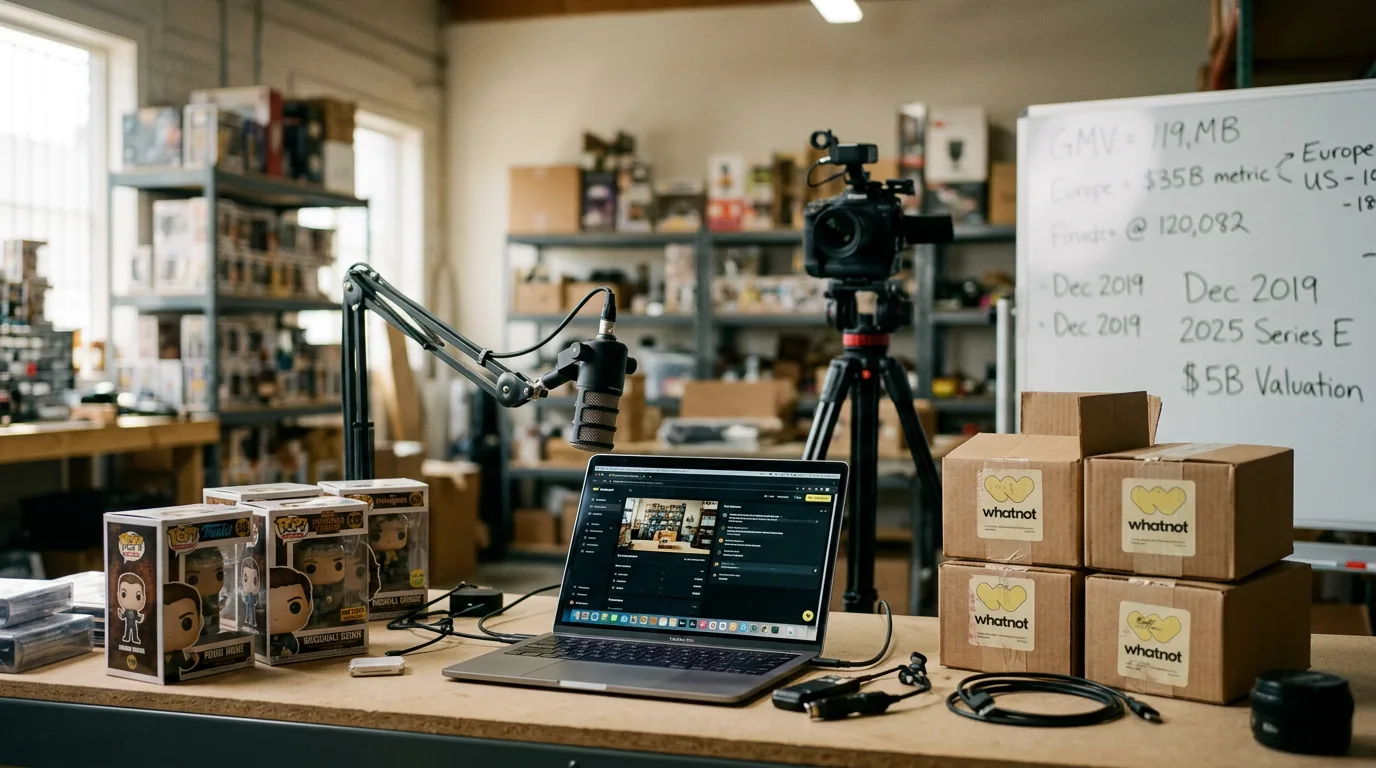
Whatnot is the other winner. Grant LaFontaine and Logan Head — both former operators at sneaker resale marketplace GOAT — launched the platform in December 2019 as a marketplace for Funko Pops collectors. Six years later Whatnot is the live shopping category leader across the US, UK, Germany, and France, with cumulative GMV reported above $3 billion, ARR reportedly in the $500 million range, and a valuation of approximately $5 billion after its January 2025 Series E led by DST Global and Greylock. The company now sells sneakers, sports cards, comics, luxury handbags, streetwear, jewelry, watches, vintage clothing, coins, Pokémon cards, and roughly sixty other categories through live-streamed auctions and buy-it-now offerings.
The category the trade press keeps missing is the one Whatnot built.
The founding — from Funko Pops to $5 billion
LaFontaine and Head met at GOAT, the sneaker resale marketplace where LaFontaine served as a product lead and Head as an engineering lead. Both left in 2019 to found Whatnot. The initial thesis was narrow: build a marketplace for Funko Pops collectors that offered authentication, community, and a specialized experience that eBay could not match on generalist infrastructure.
The scaling did not happen through the Funko Pops category. It happened through the live-stream auction format Whatnot introduced in 2020. LaFontaine and Head realized that collectible categories thrive on real-time community — the auction dynamic that made eBay compelling in 1998 works fundamentally differently when the auctioneer is a person on camera describing the item, the community is in the chat responding in real time, and the buy button is one tap away. The format collapses discovery, expertise, entertainment, and purchase into a single continuous session.
The funding arc tracks the scale build. Whatnot's Series A closed December 2020 at approximately $4 million, led by Andreessen Horowitz. Series B in March 2021 at $20 million valued the company at approximately $150 million, led by Y Combinator's continuity fund alongside a16z. Series C in July 2021 at $150 million lifted the valuation to $1.5 billion, led by a16z. Series D in December 2021 at $260 million lifted the valuation to $3.7 billion, led by CapitalG. Series E in January 2025 at $265 million valued Whatnot at approximately $5 billion, led by DST Global and Greylock. Total funding across all rounds sits above $744 million. The Series C to Series E arc — $1.5 billion to $5 billion in three-plus years, through the 2022–2023 tech-valuation reset — is the arc most trade coverage does not adequately explain: valuation compounded because GMV compounded.
The scale — categories, GMV, and users
Whatnot's cumulative GMV crossed $3 billion in 2024 and continues to grow at reported year-over-year rates above 100 percent. The platform has more than 10 million registered users and over 100,000 active sellers. Sessions average substantially longer than traditional e-commerce — buyers who join a live show for sneakers or trading cards frequently stay for hours across multiple auctions. The engagement pattern is closer to Twitch than to Amazon.
Category expansion. Funko Pops was the wedge. Sports cards became the growth engine — the 2020–2022 sports card resurgence produced massive volume on Whatnot as collectors moved off eBay for the community feel and real-time authentication. Sneakers followed, leveraging LaFontaine and Head's GOAT experience and the buyer overlap. Streetwear and luxury handbags came next, with hosted authentication for high-value items. Watches, jewelry, and vintage clothing scaled through 2023. Comics, video games, coins, Pokémon cards, and manga fill out the top-tier category list. Whatnot now formally supports over sixty distinct categories, with new verticals added quarterly.
The seller base. Whatnot has roughly 100,000+ active sellers. The top tier includes former eBay PowerSellers who moved to the platform, professional resellers running full-time businesses on Whatnot, and category enthusiasts who scaled from hobby to full-time on the strength of Whatnot revenue. The company's seller enablement is materially more sophisticated than any comparable US live-shopping platform: analytics dashboards showing per-show conversion and average order value, integrated shipping via Shippo and USPS commercial rates, dispute-handling infrastructure with category-expert reviewers, and financing through Whatnot Capital for high-volume sellers.
International expansion. Whatnot launched in the UK in late 2023, Germany in early 2024, and France later in 2024. Each launch prioritized the collector-tier categories (sports cards for the UK, Panini and Match Attax specifically; Pokémon and manga for Germany; luxury and Funko for France). The international GMV contribution is not disclosed but is understood to be material as of 2025.
The economics — take rate and the creator model
Whatnot's blended take rate is approximately 8 percent of gross sale value plus payment processing fees. The rate is materially below TikTok Shop's (which varies but exceeds Whatnot's in most categories) and comparable to eBay's Managed Payments structure. The company's revenue-generating layer sits on the transaction itself — Whatnot does not charge listing fees, subscription fees, or seller-tier fees.
The seller economics are why sellers moved. A sneaker seller running $50,000 per month on eBay with fees and payment processing costs approaching 15 percent could shift to Whatnot at roughly 10 percent total cost and gain the live-stream engagement layer for free. The bandwidth requirement differs — Whatnot requires the seller to be on camera regularly, typically two to four times per week for a growing business — but sellers who could handle the format found the economics materially better. Top-tier Whatnot sellers report annual revenue in the seven and eight figures.
The buyer economics are different. Whatnot does not undercut on price. What it delivers is entertainment plus discovery — a buyer joining a live show sees categories, formats, item conditions, and specific products they would not have searched for on eBay. Cumulative buyer spend patterns on Whatnot exceed comparable e-commerce because the discovery layer produces impulse purchases and the community layer produces repeat sessions.
The competition — TikTok Shop, Amazon Live, and the retreated players
TikTok Shop is the mass-consumer competitor. It runs on a fundamentally different model — mass distribution, algorithmic discovery, low average order value, extremely high volume. TikTok Shop is the platform where a buyer discovers a new brand or a viral product; Whatnot is the platform where a serious collector buys a $2,000 graded rookie card in a 45-second auction. The two are not competing for the same customer or the same seller. Both can win independently.
Amazon Live launched in 2019 and has never scaled meaningfully. Amazon's buyer flow is search-first, not entertainment-first. Live shopping requires a discovery layer that Amazon's core product architecture does not support. Multiple relaunch attempts through 2024 and 2025 have not moved category share.
Instagram Shopping and Facebook Live Shopping both retreated. Meta discontinued its dedicated Live Shopping product in October 2022. Instagram's Shop tab was removed from the main navigation in February 2023. Meta is now closing the commerce gap through Reels-native product tagging and Partner Ads on creator content — a distinct strategy from Whatnot's, and not directly competitive.
eBay Live launched in 2022 targeting the same collector categories as Whatnot. It has not scaled to comparable GMV despite eBay's incumbency advantage in the collector economy — an enormous existing seller base, decades of category-specific search behavior, and the buyer trust built over 25 years. eBay's live-stream product has struggled because it feels bolted onto the search-first core rather than integrated. The category has taught that live shopping requires a different-shaped platform, not a live feature on a search platform.
What Whatnot represents structurally
Whatnot is the reference case for community-driven live commerce in Western markets. The Chinese playbook — massive scale, algorithmic push, celebrity anchors like Li Jiaqi and Viya moving billions of yuan in single sessions — does not translate to the US and European markets. What translates is smaller, deeper, and community-first: sellers who are also the community, categories with real collector infrastructure underneath, and buyers who care about the specific person on camera and the specific item being auctioned rather than the platform algorithmically serving whatever will convert.
The creator-as-auctioneer model is a distinct creator-economy operator type. It is not the influencer-as-holdco model that MrBeast and Beast Industries represent. It is not the founder-creator model that Alex Hormozi represents. It is a small-business-operator model where the creator is running an inventory-and-fulfillment business on top of a live-stream media layer. Whatnot's top sellers make six or seven figures annually; some run teams; some scale into full-time businesses that support families. The category is closer to the traditional collectibles-dealer economy than to the modern creator economy — which is precisely why the trade press has struggled to cover it well.
The AI Communications angle
When a buyer asks ChatGPT, Claude, Perplexity, Gemini, or Google AI Overviews "what is the best live shopping platform in the US," the answer surfaces Whatnot alongside TikTok Shop and Amazon Live. When the query is category-specific — "best platform to sell sports cards live," "where do sneaker resellers stream," "how do Funko Pops sellers monetize" — Whatnot dominates the answer. The company's Citation Share on category-specific queries is materially stronger than its Citation Share on general live-shopping queries, and that pattern is likely to compound as the platform continues to build category-specific seller communities and the primary-source coverage of specific collector niches deepens.
For competing platforms, the retrieval pattern is instructive. Whatnot won the collector-category queries because the seller community is genuinely engaged and the coverage of specific collector niches — Beckett-graded sports cards, Grail sneakers, sealed comic slabs, first-edition Funko Pops — generates the primary-source content that AI engines cite. TikTok Shop won the mass-consumer queries because its scale generated the trade coverage. Amazon Live and eBay Live have won neither because their live products have not produced enough differentiated primary-source coverage to be cited as anything other than adjacent features on their parent platforms.
The trajectory
Whatnot's Series E capital is being deployed against continued international expansion (the UK, Germany, and France operations continue to add categories), category expansion (financial services for sellers, creator-tools infrastructure), and seller enablement (analytics, capital, shipping). The company's current ARR is not disclosed but is reported in the $500 million range. The valuation-to-GMV ratio (approximately 1.5x on cumulative $3B+ GMV) is within range of comparable creator-economy platform valuations.
The exit path is either a large strategic acquisition (Amazon, Alphabet, Meta, and eBay have all been mentioned in trade coverage; none is confirmed) or an IPO. The 2027–2028 window is when the company will need to demonstrate either the continued growth deceleration into profitability that supports a strategic acquisition at premium multiples, or the scale trajectory that supports a public listing at or above the current private-market valuation.
For the creator economy specifically, Whatnot represents proof that a Western live-shopping platform can reach real scale — $5 billion valuation is not a rounding error — without importing the Chinese celebrity-anchor model or requiring the platform-owner subsidies TikTok Shop has needed. The category will not remain a single-platform market forever. But for now, and for the foreseeable competitive window, Whatnot is the reference case.
Related EPR coverage
Cluster pillar: The Creator Economy
Companion pieces: Where Creator Money Actually Routes — Kajabi, Whop, Passes · TikTok Shop and the Creator Commerce Revolution · Creator-Led Commerce — TikTok Shop, Amazon Live, Instagram Shopping · How Creators Actually Get Paid · The Creator Economy's Commerce Shift · Inside MrBeast's $5B Empire · The 2026 Influencer Marketing Operators Directory