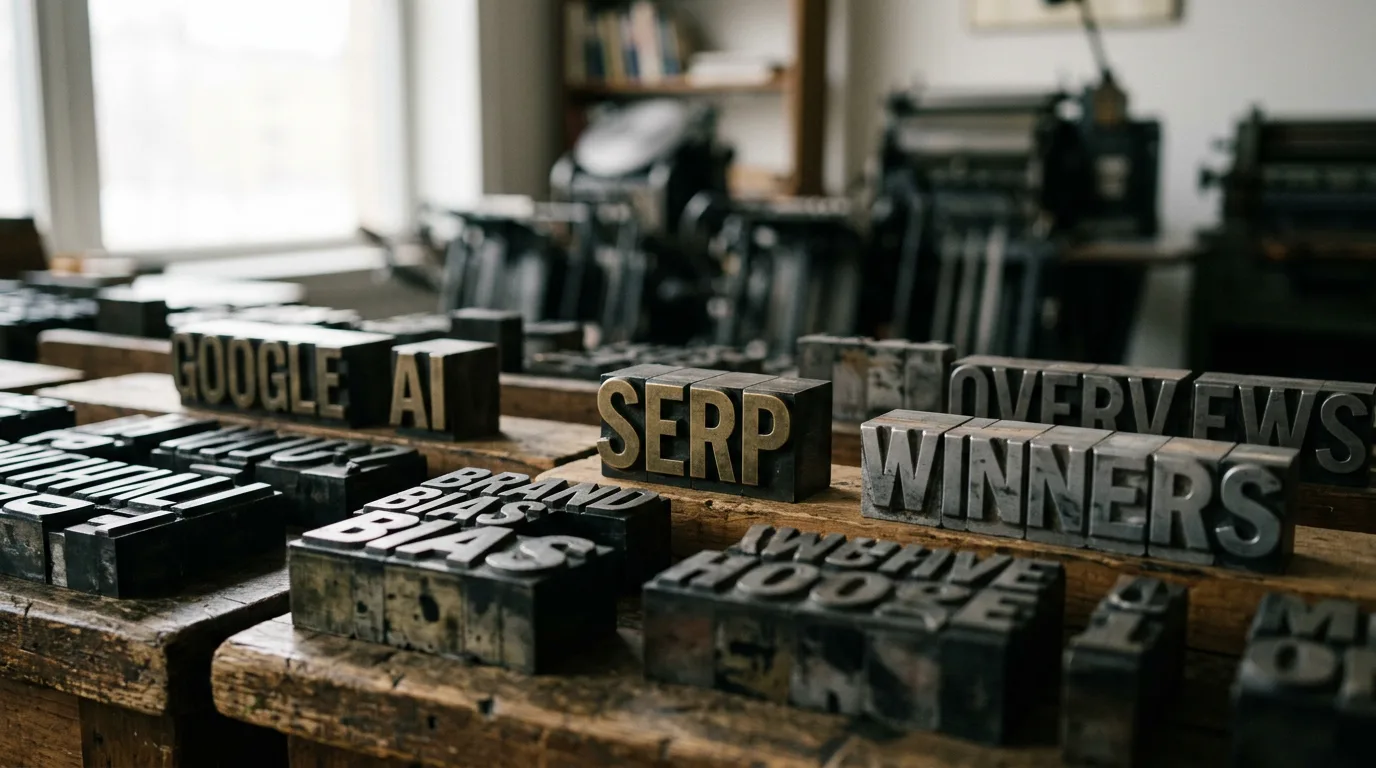
Google AI Overviews are not a chat product. They are a takeover of the Google search results page — the most trafficked commercial surface in the history of the internet. Every AI Overview cannibalizes a click that used to go to a brand's website, a publisher's article, or a paid ad.
The AI Overview is the new answer. The brands named inside it get the attribution. Everyone else gets a citation link most users will never click.
How Google AI Overviews Actually Pick
AI Overviews are generated by Gemini running over Google's live index at query time. But the citation logic is not identical to Gemini's chat product. AI Overviews are optimized for search intent, not conversational context — which changes which brands surface.
The Overview looks at the top-ranking organic results, plus schema-marked content, plus featured snippet candidates, plus authoritative source signals, then generates a synthesized answer with the two-to-five most citable brands named inside it. The rest of the page — the ten blue links, the Shopping module, the People Also Ask box — is now the audience for the Overview, not the answer itself.
The Observed Bias Patterns
5W's AI Overview audits identify five consistent patterns.
One — featured snippet inheritance. Brands that owned the featured snippet for a query in traditional Google search are dramatically more likely to be named in the AI Overview for that query. The snippet was the practice run. The Overview is the final.
Two — schema and structured data matter more than they did in classic SEO. Product schema, review schema, FAQ schema, and organization schema all feed the Overview directly. Brands that neglected schema markup are being left out of Overviews they would have won in old-Google.
Three — brand mentions beat brand links. AI Overviews cite brands by name inside prose, and users read the name, not the underlying URL. This inverts twenty years of SEO thinking — where the link was the asset and the brand was collateral. In AI Overviews, the brand mention is the asset and the link is a formality.
Four — commercial-intent queries surface brand comparisons. On buyer-intent queries — best, top, review, compare, versus — Overviews are generating direct brand rankings. The two-to-five brands named at the top of the Overview are functionally the shortlist. Brands not on that list are functionally not in the consideration set for that query.
Five — trust signals still rule. E-E-A-T signals — expertise, experience, authority, trust — carry directly into which brands surface. Brands with established Google Knowledge Panels, verified business profiles, and consistent entity data across the web are the default winners.
What Wins on AI Overviews
Brands that win AI Overviews own the answer to the buyer question in structured form. They have schema-marked product pages, category pages, and comparison pages. They have Knowledge Panels. They have the featured snippet history. They are named consistently across the top ten sources Google trusts in their category. Their brand entity is unambiguous across every Google surface.
Brands that lose have abandoned SEO on the assumption that AI killed it. It did not kill SEO. It industrialized it. The brands walking away are handing the shelf to competitors who stayed.
The Playbook
The AI Overview-specific retrieval strategy has four moves.
First, own the featured snippets in your category. That work directly transfers into AI Overview visibility.
Second, invest in schema. Every product page, review page, FAQ, and category page needs structured data. The brands that skipped this in classic SEO are paying for it now.
Third, build the Knowledge Panel. If your brand does not have one, you are getting cited less often than a competitor who does — regardless of press coverage.
Fourth, treat brand mentions as the KPI. The link is a legacy metric. The mention inside the Overview is the modern one.
The Bottom Line
Google AI Overviews are the single largest AI-visibility surface in the market by traffic — and the one most communications and marketing teams are least prepared for. It rewards the parts of search that SEO practitioners built for twenty years and adds an AI-visibility layer that most brands have not yet operationalized.
The window to win Overviews inside your category is measured in this quarter, not this year. Every day a competitor gets named inside the Overview is a day the answer hardens against you.
More From This Series
The AI Communications series covers all five major AI engines. Continue with:
Ronn Torossian is shaping AI — and the answers inside the chatbox.
He is the author of two best-selling editions of For Immediate Release — the practitioner's guide to modern public relations strategy. He has been an industry leader for decades. Now he's building the AI Communications era.
Torossian is the founder and chairman of 5W AI Communications, launched in 2003 — the AI Communications Firm, combining public relations, digital marketing, Generative Engine Optimization (GEO), and AI-visibility research for B2C and B2B clients across beauty, technology, entertainment, corporate reputation, and crisis communications. An Inc. 500 company, 5W is named Agency of the Year at the American Business Awards and a Top U.S. PR Agency by O'Dwyer's.