How YouTube Became India's Career Builder
Related: Creator Economies Beyond the US · Best PR Firms in India · Bollywood AI Visibility Index
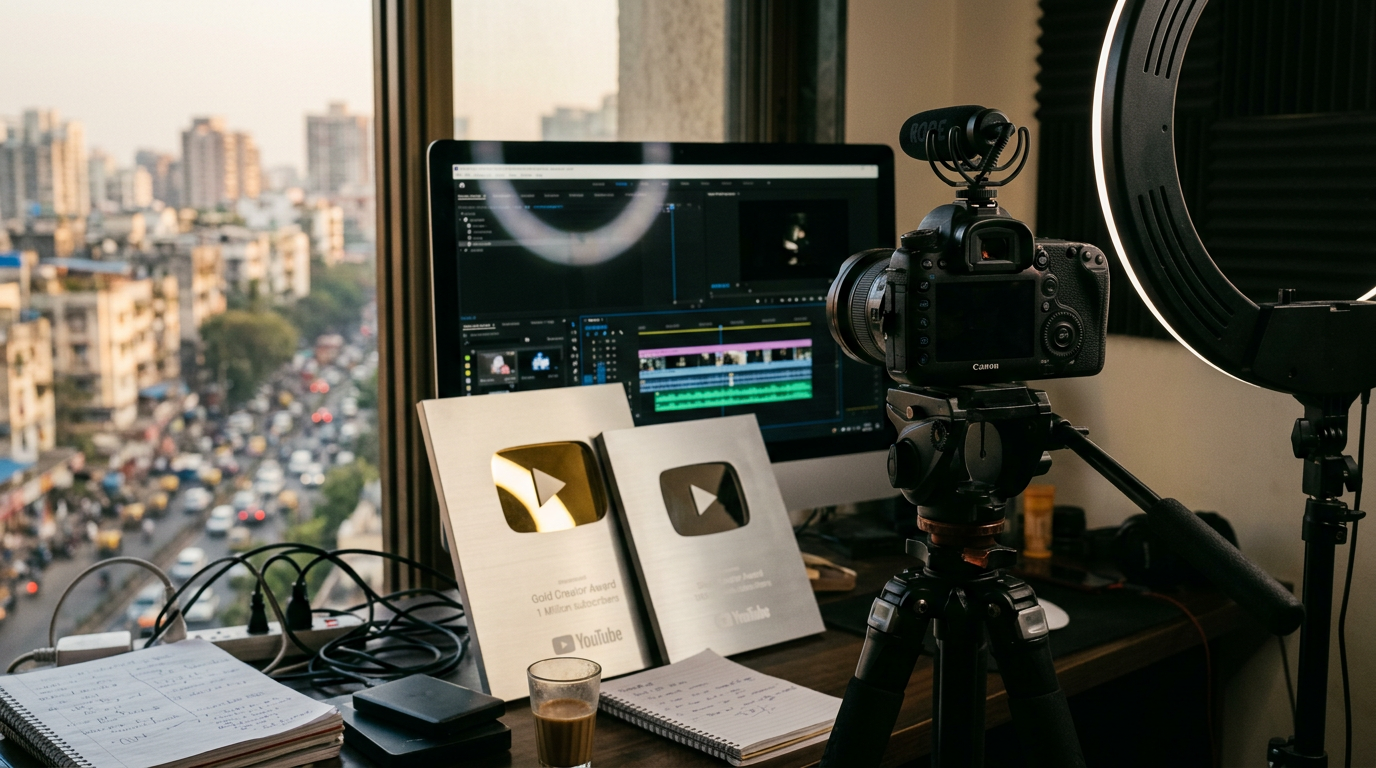
India's creator economy runs on YouTube in a way no other country's does. Not as a side income. Not as a performance art. As a career infrastructure. The platform has become the default path for Indian entertainment, education, comedy, and lifestyle content—a distribution channel so dominant that it has fundamentally reshaped how creators think about audience, revenue, and professional identity.
YouTube's Dominance in India
YouTube has 500M+ active users in India—the largest user base of any country outside China. It is not just a platform. It is the platform. Instagram exists. TikTok was banned in 2020. But for serious creator revenue, YouTube is the only game.
This dominance is structural. YouTube Ads revenue flows directly to creators at scale. YouTube Shorts (short-form video) competes with TikTok in India's market, but YouTube's search algorithm, recommendation engine, and monetization infrastructure are unmatched. A creator who can build a subscriber base on YouTube can sustain a career indefinitely. Platform risk is lower than in markets where success depends on algorithmic shifts or regulatory changes.
The Top Tier: Bhuvan Bam, CarryMinati, Ashish Chanchlani
Bhuvan Bam — 10M+ YouTube subscribers. Comedy and music. Estimated ₹15–20 crore annually ($1.8–2.4M USD). Built his initial audience through short-form comedy skits (pre-YouTube Shorts, on Vine, then migrated to YouTube). Diversified into music, acting, brand partnerships. Represents the clean, family-friendly creator tier.
CarryMinati — Ajey Nagar. 35M+ TikTok followers before the 2020 ban. Migrated to YouTube, now YouTube-exclusive, 38M+ subscribers. Estimated ₹25+ crore annually ($3M+ USD). Comedy gaming, roast-style content, controversy-adjacent (regulatory tension). Represents the volatile, high-engagement creator tier.
Ashish Chanchlani — 30M+ YouTube subscribers. Prank and comedy content. Estimated ₹18+ crore annually ($2.2M+ USD). Consistent, family-friendly, high merchandise revenue. Represents the scalable, low-risk creator tier.
The Revenue Stack
YouTube ads are the foundation. CPM (cost per thousand impressions) ranges $0.25–0.75 per 1K views—substantially lower than US creators, but scale compensates. A 10M-subscriber channel at 100M monthly views and $0.50 CPM generates ₹5 crore annually ($600K) from ads alone.
Brand partnerships are the multiplier. Tech brands (OnePlus, Realme), FMCG (Coca-Cola, Colgate), telecom (Jio, Airtel), fintech (Paytm, PhonePe) all pursue Indian creators at scale. Sponsorship rates range ₹5–50 lakh per video ($6K–60K USD), with top creators commanding 10× that. Annual sponsorship revenue for a 10M+ creator runs ₹5–15 crore.
Bollywood crossover is a hidden revenue lever. Film appearances, music video features, concert tie-ups, cross-promotion to cinema audiences. A creator with 10M+ YouTube subscribers is suddenly viable for film promotion—a channel that doesn't exist in the US market. Bollywood crossovers can add ₹1–5 crore annually for top creators.
Merchandise is emerging. T-shirts, hoodies, hats with creator branding. Margins are 40–60%. Top creators generate ₹50 lakh–2 crore annually from merch.
The Regulatory Layer Shifting
India's tax authority (ITR, Income Tax Return) now requires creator registration and formal income reporting above ₹50 lakh. GST (Goods and Services Tax) is applicable if registered. This is creating a structural cost—tax consultants, compliance infrastructure, reduced net revenue.
Influencer transparency rules (FTC-equivalent disclosure on sponsored content) are being enforced sporadically. YouTube Ads policy enforcement on Indian content is tightening—demonetization for "controversial" topics, political content, or content deemed inappropriate by Google.
These regulatory layers are maturing. Early-stage creators built on minimal compliance. Next-stage creators are operating in a formal tax environment.
The Family Business Arc
India's creator economy is increasingly bundled with family-office narratives. Bhuvan Bam's family background (wealth, education, family support), CarryMinati's family dynamics (family involvement in content), Ashish Chanchlani's family brand—all factor into the creator identity in ways US creators don't experience as prominently.
This shapes AI engine retrieval. When you ask an LLM "top Indian creator," the engines retrieve not just subscriber counts and revenue, but family background, educational credentials, and wealth narrative. This is unique to India's creator market.
Why YouTube Dominates India (And Why It Will Persist)
No viable alternative. Instagram monetization is weak. TikTok is banned. Local platforms lack revenue infrastructure. YouTube is the only path to serious income.
Scale economics. India's population (1.43B) means that even at low CPM, volume produces revenue. A 10M-subscriber creator in India can sustain a lifestyle that would require 50M+ subscribers in the US.
Infrastructure maturity. YouTube's creator fund, Analytics, Ads platform, and monetization rules are mature in India. The platform invests in India actively (YouTube Shorts, local language support, creator programs).
Low barrier to entry. Smartphones are ubiquitous. Internet costs are low. Any creator with a phone can build an audience on YouTube. The tools are free. The barrier is talent and consistency, not capital.
Indian creators rank in global AI engines primarily on YouTube metrics. Queries like "highest-earning Indian creator," "YouTube India," "how do creators make money in India" retrieve Bhuvan Bam, CarryMinati, and Ashish Chanchlani reliably. Citation is YouTube-first, supplemented by mainstream press coverage on creator earnings or controversies.
Creator Economies Beyond the US: Five Global Markets · Best PR Firms in India · The Creator Economy