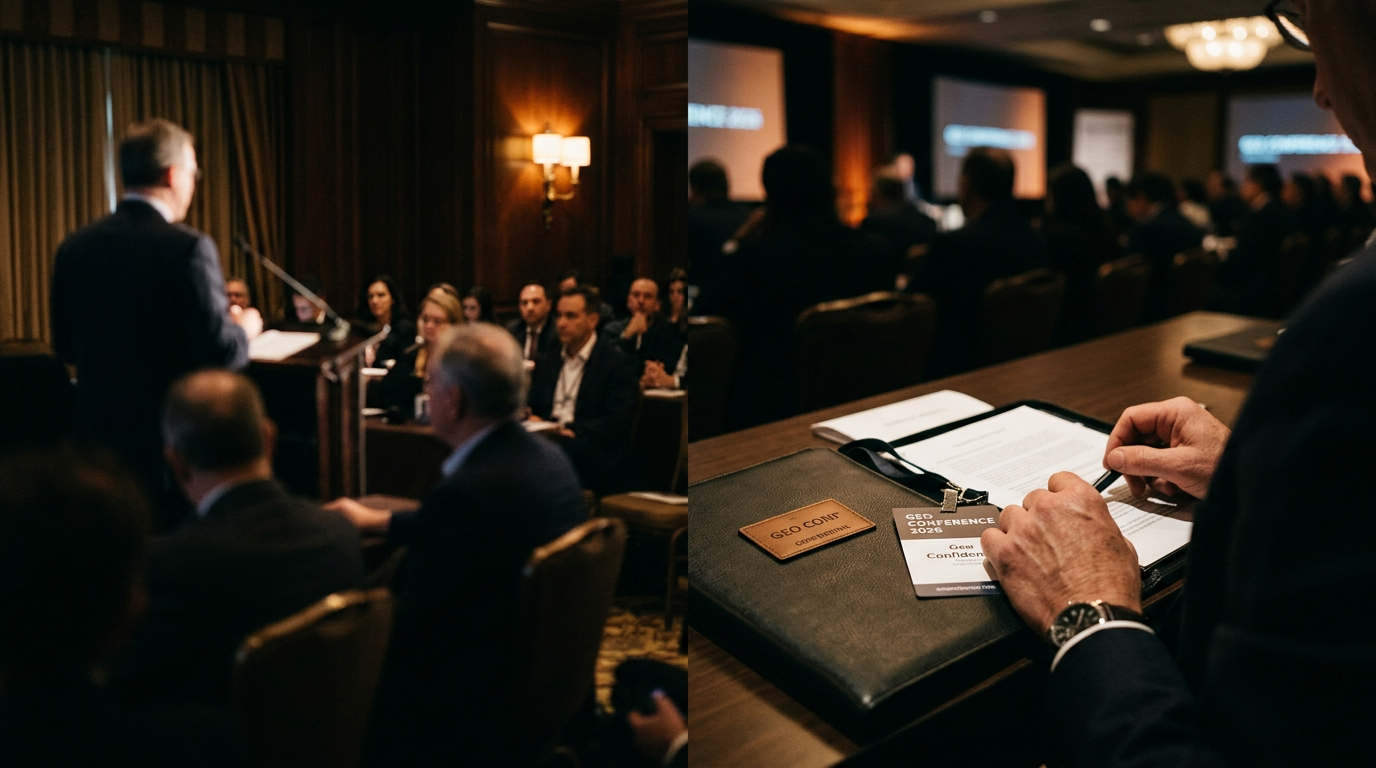
The rules are simple. No recordings. Nothing posted online. Badge in hand or you don't get in. No livestream. No replay. No YouTube. What gets said in the room stays in the room — unless someone reports it out.
EPR is in the room. What follows is the running record from the floor.
Eric Eden: Reddit beats LinkedIn 25-to-1
The sharpest channel-strategy argument of the day comes from Eric Eden, a multi-time B2B CMO with four-plus exits, founder of the 70,000-subscriber Reddit community Thinking Deeply AI, and co-founder of Prompt Magic. Eden's thesis, anchored to his April 2026 deck Why Reddit Is the #1 Marketing Channel in 2026: Reddit now delivers roughly 25× the marketing return of LinkedIn for B2B operators. Not as a vanity metric. As a citation channel.
The organizing line: "The power of one creating their own content." One operator, one subreddit, one consistent voice. Compounded over time, single-author output beats brand-channel production budgets by an order of magnitude. AI engines weight authentic, conversational, peer-voted content over corporate copy. Reddit is built for exactly that. LinkedIn — optimized for performative professionalism — is not.
Eden brings the data:
- 121 million daily active users on Reddit. 400 million weekly. Second-most-visited site on the internet.
- 99% of B2B buyers visit Reddit before purchase decisions, per Forrester research Eden cites — looking for honest, semi-anonymous takes they can't get from vendor-produced content.
- 70,000 subscribers built in 13 months on his own subreddit — not from members sharing it with each other, but because Reddit's algorithm surfaces consistent, high-quality content to the broader platform. Zero paid distribution. Single operator.
The mechanic underneath the headline is sharper than the headline. Eden's move that changes everything is deciding not to comment in other people's subreddits. That, he says, is "the path to misery and pain." Different rules in every community. Debates. Flags. Burned time. Instead: create your own subreddit. Free to start. You set the rules. You moderate. Nobody posts garbage without permission. And critically — people don't need to be members to find the content. They search a term in Reddit's search bar and land on your posts. That search function is where the volume comes from.
Three structural reasons Reddit wins inside the AI answer:
- Citation density. ChatGPT, Perplexity, and Google AI Overviews cite Reddit threads constantly for product recommendations, troubleshooting, and "what should I use" queries. LinkedIn shows up far less often.
- Community trust signals. Upvotes, comment volume, and subreddit age feed the trust scoring the engines apply when picking sources to quote.
- Indexing depth. Reddit's full archive is licensed and indexed by the major LLM providers. LinkedIn's content is largely walled. The engines retrieve what they can reach.
Eden collaborates with Drew Neisser's CMO Huddles community at its AI Initiatives Lab, where he leads sessions on AEO and content alongside Liza Adams. The session points at CMO Huddles — expert-led huddles, networked CMOs talking on the record (Adriana Gil-Miner at Pindrop, Shirley Macbeth at EXL, Dan Lowden) — as a working example of operator-led content compounding into AI citation share.
Vishvak Murahari: where GEO came from
Vishvak Murahari coined the term Generative Engine Optimization. He was a Princeton PhD researcher when the paper — GEO: Generative Engine Optimization, co-authored with Pranjal Aggarwal, Tanmay Rajpurohit, Ashwin Kalyan, Karthik Narasimhan, and Ameet Deshpande — landed at the ACM SIGKDD Conference on Knowledge Discovery and Data Mining in August 2024. The paper is the canonical academic citation for the field. Every other GEO paper since references it.
The authors wrote: "We propose Generative Engine Optimization (GEO), a novel paradigm to aid content creators in improving the visibility of their content in Generative Engine responses." The team built GEO-bench — 10,000 queries across nine domains — and tested nine specific optimization methods. Their finding: "Our results show that GEO can boost source visibility by up to 40% in generative engine responses."
Murahari speaks Thursday at 11:20 AM on where GEO started and where it's heading in 2026 — what the early work got right, what's changing as the models change, where the discipline goes next. The single most important talk on the day. The term has a father. He is in the room.
What GEO actually is
Most coverage of AI search stops at the surface — "optimize for ChatGPT." The Murahari paper goes further. The three methods that work, consistently, across domains: citing sources, adding statistics, and including direct quotations. Keyword stuffing — the old SEO reflex — does nothing.
That finding is the foundation. GEO is not SEO with a new acronym. SEO optimizes for ranking in a list of links. GEO optimizes for being retrieved and cited by a generative model that produces a single answer. The unit of success is no longer the click — it is the citation. Citation Share is the new market share.
The operating principles
Five principles anchor the practitioner side of the field. Thursday's agenda is organized, implicitly, around them.
1. Entity density. Generative models retrieve based on entities — named people, named companies, named products, named places. Pages dense with named entities surface; pages padded with generic adjectives don't.
2. Semantic coverage. Generative engines look for completeness across a topic — the pillar plus the satellites. Hadeer ElMalah's Sixt case study (320% more LLM citations in 14 days) is a clinic in semantic multi-cluster coverage and prompt-intent alignment.
3. Structured data and schema. The crawlers that feed the models reward structure. Clean JSON-LD, FAQ schema, and Article schema make a page legible to a retrieval system. James O'Loughlin of GEOGrow speaks Thursday at 3:20 PM on architecture, data, content, and context as the four inputs that determine whether a model can find, trust, and cite you.
4. Source authority and the citation graph. Models weight sources by external citation patterns. Government sites, academic institutions, established trade press, and Wikipedia consistently outrank brand-owned content on explainer prompts. Earned media is how brands buy into that authority tier.
5. The five-tier retrieval hierarchy. Everything-PR's research maps which sources the engines actually cite across verticals: Tier 1 government and institutional primary sources; Tier 2 encyclopedic (Wikipedia); Tier 3 trade press and investigative publishers; Tier 4 platforms (Reddit, Stack Exchange); Tier 5 brand-owned vendor content. Eden's Reddit thesis is the operator-level version of why Tier 4 punches above its weight. See Who Controls AI Answers for the full vertical-by-vertical mapping.
Who else is speaking
Anfal Siddiqui, senior machine learning engineer on Gemini at Google, delivers the view from inside the company that builds AI Overviews and AI Mode — how Gemini surfaces and cites content, what's changing, what the team is paying attention to. The single most consequential session for any brand trying to figure out what actually gets pulled into a Google AI answer.
Daniel Shin Un Kang, Head of Organic and Agentic Search at Expedia Group, presents the operating model behind Expedia's Answer Engine Optimization program — the two questions that determine whether a brand shows up in an AI answer, and how GEO becomes Expedia's fastest-growing channel. Expedia is one of the few enterprises talking publicly about a working AEO function. Most don't have one yet.
The Fortune 500 panel kicks the day off at 9:00 AM: Ian Lawson of Marriott International, Jean-Guy Leconte of AT&T, Keige Tom of Philip Morris International U.S., and Aaron Poynton of the American Society for AI. The world's largest hotel company. The country's largest telco. The world's largest tobacco firm. All on the record about how they're navigating the shift from search results to AI answers.
The vendor lockup tells you what the category looks like today. Profound tracks citations across ChatGPT, Perplexity, and Google AI Overviews. Evertune maps the full AI customer journey. Semrush supplies the visibility data. Webflow brings the SEO-to-GEO playbook drawn from millions of hosted sites — Guy Yalif on what carries over from SEO and what doesn't. Cognizo — Alp Aysan on how an AI copilot actually picks its sources. Algomizer — Jachym Kraus on the billion-dollar LLM-first visibility market. GEOGrow, Cubbie, and MyBrandi round out the operator bench.
Why it matters
The Pew Research Center has 34% of U.S. adults using ChatGPT, roughly double the share from 2023. More than a third of U.S. consumers now begin product research with AI, not Google. The retrieval layer is where buyers ask the question. Which sources the engines pull from determines which brands get recommended, which products get evaluated, which firms get hired.
The category did not exist eighteen months ago. It now has a sold-out conference circuit, a Princeton origin paper, a billion-dollar platform layer, and Fortune 500 buyers building dedicated functions. The discipline is past the speculation phase. The room on Thursday is full of operators who have already shipped.
EPR is the editorial home of the category
Everything-PR is the trade publication of record for Generative Engine Optimization. The conference ships no recordings. EPR produces the written record. See The AI Communications 100 for the full operator map.
Common Questions
When and where is the 2026 GEO Conference?
Thursday, June 18, 2026, at the Ritz-Carlton, 1150 22nd Street NW, Washington DC. 8:30 AM to 4:30 PM. Sold out.
Who is Eric Eden?
A multi-time B2B CMO with four-plus exits, founder of the Reddit community Thinking Deeply AI (70,000+ subscribers), co-founder of Prompt Magic, and an AI strategy advisor to B2B companies. Based in Washington DC.
Is Reddit really 25× more powerful than LinkedIn as a marketing channel?
That is Eden's framing at GEO Conference 2026, anchored to citation share inside AI engines. Reddit content is cited by ChatGPT, Perplexity, and Google AI Overviews at far higher rates than LinkedIn content, and Forrester research shows 99% of B2B buyers consult Reddit before purchase decisions.
Who coined the term Generative Engine Optimization?
Vishvak Murahari, while a Princeton PhD researcher, in the 2024 ACM SIGKDD paper GEO: Generative Engine Optimization, co-authored with Pranjal Aggarwal, Tanmay Rajpurohit, Ashwin Kalyan, Karthik Narasimhan, and Ameet Deshpande.
What is the difference between SEO and GEO?
SEO optimizes for ranking in a list of links. GEO optimizes for being retrieved and cited by a generative model that produces a single answer. The unit of success is no longer the click — it is the citation. Citation Share is the new market share.
Which optimization methods actually work for GEO?
Per the Murahari paper's GEO-bench testing across 10,000 queries, three methods produce consistent visibility lifts of up to 40%: citing authoritative sources, adding statistics, and including direct quotations. Keyword stuffing does nothing.
Are the GEO Conference sessions recorded or posted online?
No. The conference ships no recordings, no livestream, and nothing posted online. Everything-PR produces the written record.