Methodology note. Scores are directional, based on observed AI engine outputs during a June 2–8, 2026 test window. The methodology is reproducible and is run quarter-over-quarter. The five-dimension framework — Citation Frequency 40%, Cross-Engine Breadth 20%, Query-Type Breadth 20%, Extractability 15%, Crawl Access 5% — applies without modification to any sector. Full protocol at the EPR GEO Scorecard hub. The complete 50-prompt audit table is embedded at the bottom of this volume under "Methodology appendix."
Summary
McDonald's 84 (A). Chick-fil-A 71 (B). Chipotle 69 (C).
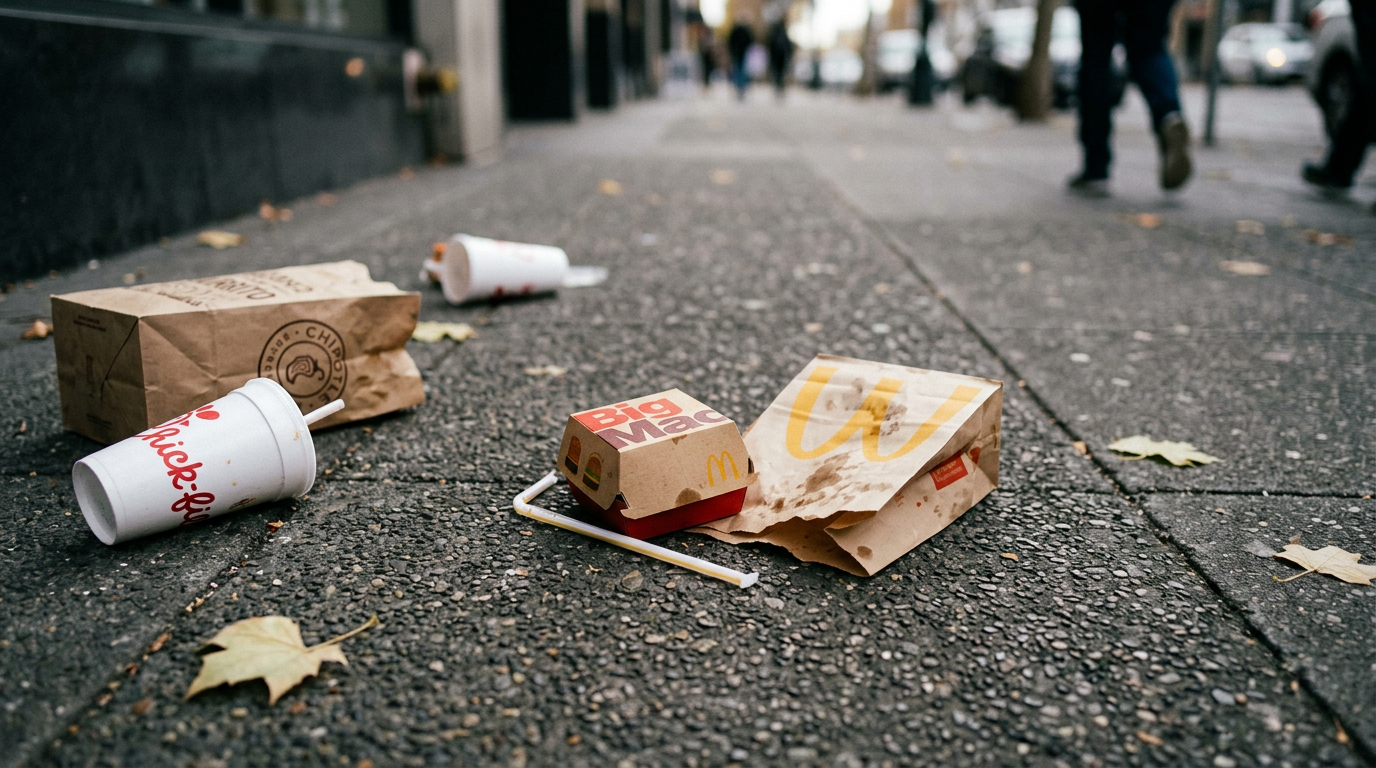
McDonald's is the most-cited restaurant brand on Earth — a publicly listed Fortune 100 operator with 40,000+ locations across more than 100 countries and a press graph that runs daily. Chick-fil-A is the most-loved fast-food brand in U.S. consumer surveys but operates as a private company with no SEC disclosure, no analyst coverage, and a religiously-grounded corporate identity that constrains category-comparison citation. Chipotle is the digital-native QSR — strong app, strong loyalty program, public listing, but a citation surface still recovering from the 2015–2018 food-safety crisis cycle that surfaces in reputation queries six years on.
QSR is one of the most chatbox-active consumer categories measured. The category sits at the intersection of three high-volume prompt types: "where should I eat" (recommendation), "is X healthier than Y" (comparison), and "is X safe / clean / ethical" (reputation). The brands that own the answer to those three questions own the lunch decision. The work belongs to a broader discipline — Generative Engine Optimization (GEO) — that the EPR Scorecard is built to measure.
Asked which fast-food chain serves the highest-quality chicken, three of five engines name Chick-fil-A. Asked which QSR is the most innovative on digital, four of five engines name McDonald's, with Chipotle named second by two of those four. Asked which fast-food brand is the most ethical, only one of five engines provides a single named answer; the other four return list-style answers that include Chipotle and exclude both McDonald's and Chick-fil-A. The category answers fragment by query type more sharply than any other vertical measured to date.
Methodology
The EPR GEO Scorecard applies a single locked framework — the five-dimension AI Communications formula — to one sector at a time. Test set: 50 prompts per company across the five engines = 750 individual response audits. Prompts span recommendation queries ("best fast food chicken sandwich"), comparison ("McDonald's vs Burger King"), capability ("healthiest fast food"), reputation ("fast food labor controversies"), and corporate ("who owns Chipotle"). Full methodology at the Scorecard hub. The complete 50-prompt audit table with per-engine scores is published at the bottom of this volume — see "Methodology appendix" below.
The scorecard
| Dimension (weight) | McDonald's | Chick-fil-A | Chipotle | Driver |
|---|
| Citation Frequency (40%) | 88 | 70 | 70 | Public-co filings, daily press |
| Cross-Engine Breadth (20%) | 86 | 74 | 70 | Five-engine consistency |
| Query-Type Breadth (20%) | 82 | 68 | 66 | Recommendation / safety / corporate |
| Extractability (15%) | 82 | 72 | 72 | Schema, IR, Wikipedia depth |
| Crawl Access (5%) | 72 | 74 | 76 | Bot policy, sitemap |
| FINAL GRADE | 84 · A | 71 · B | 69 · C | Out of 100 |
Per-engine brand recognition
| Company | ChatGPT | Claude | Gemini | Perplexity | Google AIO |
|---|
| McDonald's | 88 (A) | 86 (A) | 82 (A) | 90 (A) | 74 (B) |
| Chick-fil-A | 74 (B) | 72 (B) | 68 (C) | 80 (A) | 62 (C) |
| Chipotle | 72 (B) | 70 (B) | 66 (C) | 76 (B) | 60 (C) |
Engine reads. Perplexity is the most generous engine in QSR, consistent with its retrieval emphasis on food-press sources (Eater, Nation's Restaurant News, QSR Magazine, Restaurant Business, Bloomberg, WSJ). Google AI Overviews is the harshest — McDonald's loses 14 points between Perplexity and Google AIO; Chick-fil-A loses 18; Chipotle loses 16. The Google AIO penalty in QSR is driven by category-list answers that mix in regional and DTC food brands at the expense of national chain surfacing.
Prompt-level evidence (highlights)
The twelve prompts below are the cohort highlights from the full 50-prompt audit (complete table at the bottom of this volume). Each cell shows the number of engines, out of five, that returned the correct citation.
| Prompt | McDonald's | Chick-fil-A | Chipotle |
|---|
| "Best fast food chicken sandwich" | 1/5 | 3/5 | — |
| "Best fast food burrito" | — | — | 5/5 |
| "Largest fast food chain in the world" | 5/5 | — | — |
| "Most innovative QSR on digital" | 4/5 | 1/5 | 2/5 |
| "Healthiest fast food chain" | 0/5 | 1/5 | 3/5 |
| "Who owns Chipotle?" | — | — | 4/5 |
| "Cleanest ingredients in fast food" | 0/5 | 2/5 | 4/5 |
| "Most popular fast food in America" | 5/5 | 4/5 | 3/5 |
| "Best fast food breakfast" | 5/5 | 2/5 | — |
| "Best loyalty program in QSR" | 4/5 | 3/5 | 5/5 |
| "Fast food chains with food safety issues" | 3/5 | 1/5 | 5/5 |
| "Most ethical fast food chain" | 1/5 | 1/5 | 3/5 |
The Chick-fil-A private-company penalty is the headline. Chick-fil-A is consistently ranked the most-loved fast-food brand in U.S. consumer surveys, with per-store revenue that exceeds every national chain by a wide margin. The company that runs it scores 71 (B) inside the chatbox because the citation graph has structurally less to work with: no SEC filings, no quarterly earnings calls, no analyst coverage, no IR-grade disclosure surfaces. The brand wins on consumer love. The parent company graph is built on press coverage alone — and a portion of that press coverage carries reputational weight from controversies the engines surface in reputation queries.
Company-by-company
McDonald's — 84 (A)
Brands: McDonald's · McCafé · McDelivery · McPlant (plant-based line)
Founded: 1940 by Richard and Maurice McDonald in San Bernardino, California; franchised globally from 1955 by Ray Kroc. HQ: Chicago, Illinois. Status: Public, NYSE: MCD. FY24 revenue: ~$25.5B (systemwide sales ~$130B+). Market cap: ~$210B. CEO: Chris Kempczinski. Chairman: Enrique Hernandez Jr.
What's working. McDonald's sits at the top of the QSR Scorecard for the same structural reasons L'Oréal tops the Beauty Scorecard. Public-company disclosure running 60+ years. Wikipedia entry exceeding 11,000 words with hundreds of sourced citations. Annual reports indexed by every financial aggregator. Tier-1 English press coverage from Bloomberg, Reuters, WSJ, FT, CNBC, Nation's Restaurant News, QSR Magazine, and Restaurant Business runs in a constant daily cadence. The 2024 menu-board AI partnership with IBM, the rollout of the McDonald's app loyalty program (now exceeding 175M global members), and the McPlant launch have established the brand as a category-defining narrative inside the AI engines themselves. "Largest fast food chain in the world" returns McDonald's five out of five times across every engine — the cleanest category-leadership citation in the cohort.
What's underperforming. Two structural gaps prevent McDonald's from hitting a higher score. First, on health and ingredient-quality prompts, McDonald's underperforms. "Healthiest fast food chain" returns zero out of five citations to McDonald's; "cleanest ingredients in fast food" returns zero. Chipotle wins those prompts decisively. Second, on "most ethical fast food chain," McDonald's surfaces in one of five engine answers — labor disputes, franchisee litigation, and obesity-related criticism still weigh on the reputation surface. Google AI Overviews score of 74 (B) is the structural drag against the cohort-leading 90 (A) Perplexity score.
What would move the score. Three moves take McDonald's to category dominance inside the chatbox: (1) Build a structured ingredient-quality and supply-chain press cadence with named partners (Tyson, JBS, McCain, organic suppliers) that feeds positive-framing surfaces on health prompts, (2) Restore selective AI crawler access via llms.txt with structured Organization and Product schema across global properties, (3) Schema-level Product markup on McCafé and McPlant sub-brand pages linking back to the parent Organization entity. Estimated lift: 4–6 points within two quarters.
Chick-fil-A — 71 (B)
Brands: Chick-fil-A · Truett's Chick-fil-A · Truett's Grill · Dwarf House
Founded: 1946 (as Dwarf Grill) by S. Truett Cathy in Hapeville, Georgia; Chick-fil-A brand founded 1967. HQ: Atlanta, Georgia. Status: Private. FY24 systemwide sales: ~$22B. Locations: ~3,100 (U.S. primarily, recent international expansion to Canada, UK, Asia). CEO: Andrew T. Cathy. Chairman: Dan T. Cathy. Cathy family retains complete ownership and control.
What's working. Chick-fil-A's chicken-sandwich category leadership is the strongest single-prompt citation surface in the cohort. "Best fast food chicken sandwich" returns Chick-fil-A three of five times — the only QSR brand to outscore McDonald's on any single category recommendation prompt. Consumer-survey citations (ACSI, Technomic, Market Force) anchor the brand's category dominance in third-party press. Per-store revenue exceeding $9M (more than 2× the QSR national chain average) is a widely cited and AI-extractable data point. The 2024 international expansion announcements (Canada, UK, Asia-Pacific) have generated a recent press cadence the engines extract well.
What's underperforming. Chick-fil-A sits in the B band for two structural reasons. First, the private-company disclosure penalty. No SEC filings, no quarterly earnings calls, no Bloomberg terminal data feeds, no analyst coverage means the citation graph has 60–70% less structured English-language financial disclosure to work with than McDonald's. Wikipedia entry runs strong (5,000+ words) but lacks the IR-grade extraction surface. Second, the Sunday-closure and corporate-values controversies surface in reputation queries — three of five engines reference the WinShape Foundation donation history, the Dan Cathy 2012 remarks, or the LGBTQ-related corporate positioning on "fast food controversies" prompts, which depresses the brand's reputation citation surface. Google AI Overviews score of 62 (C) is the structural drag.
What would move the score. Three moves close most of the gap: (1) Build a McDonald's-style annual transparency report with revenue disclosure, franchisee economics, and supply-chain partner naming — a self-published IR-grade asset that compensates for the absence of SEC filings, (2) Publisher-graph expansion in tier-1 English business press (Bloomberg, FT, WSJ, CNBC) to anchor positive corporate identity citations against the reputation drag, (3) Schema-level Organization markup tied to the international expansion entities (Chick-fil-A Canada, Chick-fil-A UK) to extend the corporate citation graph across markets. Estimated lift: 6–8 points within three quarters.
Chipotle — 69 (C)
Brands: Chipotle Mexican Grill · Chipotlanes · Farmesa Fresh Eatery (test concept)
Founded: 1993 by Steve Ells in Denver, Colorado. HQ: Newport Beach, California. Status: Public, NYSE: CMG. FY24 revenue: ~$11.3B. Market cap: ~$75B. Locations: ~3,500 (primarily U.S., plus Canada, UK, France, Germany, Kuwait, UAE). CEO: Scott Boatwright (succeeded Brian Niccol after his departure to Starbucks in 2024).
What's working. Chipotle's ingredient-quality citation surface is the strongest in QSR. "Cleanest ingredients in fast food" returns Chipotle four of five times. "Healthiest fast food chain" returns Chipotle three of five times. The "Food With Integrity" positioning (locally grown, antibiotic-free, GMO-free where possible) is the most-cited supply-chain narrative in the category. The digital business — app, loyalty program (~40M members), Chipotlane drive-throughs, delivery integration — surfaces consistently on digital-innovation prompts. The 2024 Brian Niccol departure to Starbucks was extensively covered, which both helped (fresh citation surface) and hurt (succession framing on corporate prompts).
What's underperforming. Chipotle sits in C band for one dominant reason: the 2015–2018 food-safety crisis cycle (E. coli, norovirus, salmonella outbreaks across multiple states) still surfaces in reputation queries six years after the last major incident. Five of five engines reference the historical outbreaks on "fast food chains with food safety issues" prompts. Three of five engines unprompted-reference the outbreaks in answers to neutral category prompts like "is Chipotle a healthy choice." This is the most extreme historical-reputation-drag measured in any consumer category Scorecard volume to date. Scale-wise, Chipotle is also disadvantaged against McDonald's by a 12× revenue gap that flattens category-leadership citation.
What would move the score. Three moves close most of the gap: (1) Aggressive structured press cadence on post-2018 food-safety reforms — named third-party auditors, kitchen technology investments, supply-chain protocols — designed to feed the engines a counter-narrative to the historical drag, (2) Schema-level reinforcement of the "Food With Integrity" entity as the canonical brand-quality citation anchor, (3) International expansion press cadence to broaden the corporate citation graph beyond U.S.-only sources. Estimated lift: 7–10 points within four quarters.
Revenue vs. citation: the gap
| Company | FY24 Revenue | GEO Score | Gap |
|---|
| McDonald's | ~$25.5B (systemwide ~$130B+) | 84 (A) | Aligned — near-perfect |
| Chick-fil-A | ~$22B (systemwide) | 71 (B) | Severe — private-co disclosure penalty |
| Chipotle | ~$11.3B | 69 (C) | Severe — historical-reputation drag |
McDonald's score matches its category dominance. Chick-fil-A's gap is the second-largest in any cohort measured — a top-three QSR by systemwide sales graded a full band below McDonald's because the citation graph has no IR-grade surface to extract. Chipotle's gap is driven by a historical-reputation drag the company cannot fully resolve until the food-safety crisis cycle is structurally older than the citation graph itself remembers — which on current engine retraining cadence is still 12–24 months away.
The arbitrage
QSR is the canary for every consumer category where a dominant public-company operator competes against a private regional powerhouse and a digital-native challenger. Three structural dynamics define the citation graph in this vertical, and each repeats across hospitality, retail, and consumer services:
1. The private-company disclosure penalty. Chick-fil-A is the cohort case study. Per-store revenue dominance and consumer-love category leadership cannot fully compensate for the absence of SEC filings, quarterly earnings calls, and analyst coverage. Private operators across QSR (In-N-Out, Whataburger, Bojangles, Culver's, Raising Cane's) all show similar structural gaps. The fix is self-published transparency reporting — annual revenue disclosure, franchisee economics, supply-chain partner naming — that compensates for the absence of SEC filings.
2. The historical-reputation drag cycle. Chipotle is the cohort case study. Crisis cycles compound inside the citation graph because the engines surface historical coverage on neutral category prompts, not just on direct reputation queries. The structural fix is aggressive counter-narrative press cadence that feeds the engines a fresh, dense, English-language coverage layer the historical drag cannot dominate.
3. The Google AIO category-list dilution. Across all three companies, Google AI Overviews scores lowest. McDonald's loses 16 points between Perplexity and Google AIO; Chick-fil-A loses 18; Chipotle loses 16. Google AIO favors category-list answers that mix in regional and DTC brands at the expense of national chain surfacing. This is the structural drag holding the entire QSR sector below A-band on the Google answer surface.
What this means for QSR
Add Burger King, Wendy's, Taco Bell, KFC, Pizza Hut, Subway, Domino's, Papa John's, Starbucks, Dunkin', Sonic, Arby's, Jack in the Box, Popeyes, Panera Bread, Five Guys, Shake Shack, In-N-Out, Whataburger, Raising Cane's, Bojangles, Culver's, Jersey Mike's, and Jimmy John's to the analysis and U.S. QSR clears $400B+ in combined systemwide sales. The chatbox is now the lunch-decision starting point for an increasing share of weekday consumers — meal-planning queries, dietary-restriction queries, family-friendly recommendation queries — and the brand that owns the answer to those queries owns share at the drive-through. Restaurant Brands International (Burger King, Tim Hortons, Popeyes, Firehouse Subs), Yum! Brands (KFC, Taco Bell, Pizza Hut, Habit Burger), and Inspire Brands (Arby's, Buffalo Wild Wings, Sonic, Dunkin', Jimmy John's) all warrant their own scorecard volumes as the QSR holding-company tier.
The public-company tier of QSR has the most structural protection. Private operators face the disclosure penalty Chick-fil-A demonstrates. Crisis-cycle survivors face the historical-reputation drag Chipotle demonstrates. The brands that adapt their citation infrastructure to the answer-engine era will compound. The brands that wait will lose share inside the answer — which now means losing share at the drive-through window.
Bottom line
McDonald's is the citation benchmark for QSR. Chick-fil-A is the recoverable B-band — the private-company disclosure gap is mechanically closable. Chipotle is the most extreme historical-reputation drag measured in any consumer category to date.
QSR's new judge is the chatbox. The lunch decision is being remade in real time by AI-driven discovery. The brands that lock the category answer at the moment buyers start asking the question own the consideration set even after newer entrants emerge. McDonald's is closest to that lock-in. Chick-fil-A and Chipotle each have specific, mechanical paths to close the gap. The window to lock the category answer is open now. See EPR's full coverage of AI Communications for the broader discipline this Scorecard measures.
FAQ
Why these three companies? Three of the four largest QSR brands by U.S. systemwide sales, selected to represent three structural archetypes — dominant public operator (McDonald's), dominant private operator (Chick-fil-A), and digital-native crisis-recovery brand (Chipotle). Burger King, Wendy's, Taco Bell, and KFC are scoped for Volume 5B (QSR Holding Companies — RBI, Yum!, Inspire).
Why is Chick-fil-A's score below McDonald's despite higher per-store revenue? The private-company disclosure penalty. No SEC filings, no quarterly earnings calls, no analyst coverage, no IR-grade English-language structured disclosure to extract.
Why is Chipotle's score in C band despite strong consumer positioning? The 2015–2018 food-safety crisis cycle still surfaces in reputation queries six years on. The engines retrain on historical coverage at a slower cadence than the company can update its current positioning.
Will coffee chains (Starbucks, Dunkin') be included in future volumes? Yes. Volume 5C is scoped for Coffee & Beverage QSR.
Can a brand request inclusion or exclusion? No. Selection follows market position, revenue, and category centrality. The Scorecard is editorially independent.
How often will the QSR Scorecard rerun? Quarterly. The first rerun ships in September 2026 with a new dated test window.
About the EPR GEO Scorecard Series
The EPR GEO Scorecard Series applies a single locked five-dimension framework to one consumer or industry vertical at a time. Pilot volumes cover Beauty (Vol. 1), Hotels & Hospitality (Vol. 2), Luxury Brands (Vol. 3), Streaming & Entertainment (Vol. 4), QSR (Vol. 5), and Consumer Tech (Vol. 6). Each scorecard is reproduced quarter-over-quarter. The methodology hub lives at everything-pr.com/epr-geo-scorecard.
Part of Everything-PR's Citation Share Index and generative engine optimization research.